New York City Information
New York Information Topics
Home > Articles > New York City Information
From Wikipedia, the free encyclopedia
| City of New York | |||
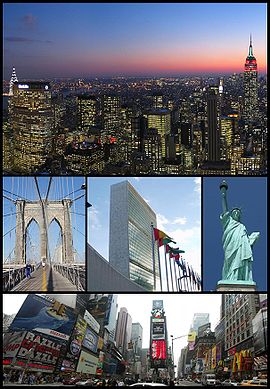 | |||
|
|||
| Nickname(s): The Big Apple, Gotham, The City That Never Sleeps, The Capital of The World (Caput Mundi), The Empire City, The City So Nice They Named It Twice. | |||
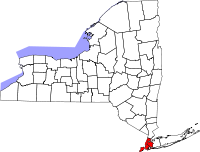 |
|||
| Coordinates: | |||
| Country | United States | ||
|---|---|---|---|
| State | New York | ||
| Boroughs | The Bronx Brooklyn Manhattan Queens Staten Island |
||
| Settled | 1624 | ||
| Government | |||
| - Mayor | Michael Bloomberg (I) | ||
| Area | |||
| - City | 468.9 sq mi (1,214.4 km²) | ||
| - Land | 304.8 sq mi (789.4 km²) | ||
| - Water | 165.6 sq mi (428.8 km²) | ||
| - Urban | 3,352.6 sq mi (8,683.2 km²) | ||
| - Metro | 6,720 sq mi (17,405 km²) | ||
| Elevation | 33 ft (10 m) | ||
| Population (July 1, 2007) | |||
| - City | 8,274,527 | ||
| - Density | 27,147/sq mi (10,482/km²) | ||
| - Urban | 18,498,000 | ||
| - Metro | 18,815,988 | ||
| - Demonym | New Yorker | ||
| Time zone | EST (UTC-5) | ||
| - Summer (DST) | EDT (UTC-4) | ||
| Area code(s) | 212, 718, 917, 347, 646 | ||
| Website: www.nyc.gov | |||

New York City
New York City (officially The City of New York) is the most populous city in the United States. The New York metropolitan area ranks among the world's most populous urban areas. It is a leading global city, exerting a powerful influence over worldwide commerce, finance, culture, and entertainment. The city is also an important center for international affairs, hosting the United Nations headquarters.
Located on the Atlantic coast of the Northeastern United States, the city consists of five boroughs: The Bronx, Brooklyn, Manhattan, Queens, and Staten Island. It is the most densely populated major city in the United States, with an estimated 8,274,527 people occupying just under 305 square miles (790 km2). The New York metropolitan area's population is also the nation's highest, estimated at 19,750,000 people over 6,720 square miles (17,400 km2) in three states.
New York is unique among American cities for its high use of mass transit, and for the overall density and diversity of its population. In 2005, nearly 170 languages were spoken in the city and 36% of its population was born outside the United States. The city is sometimes referred to as "The City that Never Sleeps" due to its extensive 24-hour subway system and constant bustling of traffic and people, while other nicknames include Gotham and the Big Apple.
Founded in 1624 as a commercial trading post by the Dutch, who called it New Amsterdam, it served as the capital of the United States from 1785 until 1790, and has been the nation's largest city since 1790.
Today, the city has many landmarks and neighborhoods that are world famous. The Statue of Liberty greeted millions of immigrants as they came to America in the late 19th and early 20th centuries. Wall Street, in Lower Manhattan, has been a dominant global financial center since World War II and is home to the New York Stock Exchange. The city has been home to several of the tallest buildings in the world, including the Empire State Building and the twin towers of the former World Trade Center.
New York is the birthplace of many cultural movements, including the Harlem Renaissance in literature and visual art, abstract expressionism (also known as the New York School) in painting, and hip hop, punk, salsa, disco and Tin Pan Alley in music. It is the home of Broadway theater.
History
The region was inhabited by about 5,000 Lenape Native Americans at the time of its European discovery in 1524 by Giovanni da Verrazzano, an Italian explorer in the service of the French crown, who called it "Nouvelle Angoulême" (New Angoulême). European settlement began with the founding of a Dutch fur trading settlement, later called "Nieuw Amsterdam" (New Amsterdam), on the southern tip of Manhattan in 1614. Dutch colonial Director-General Peter Minuit purchased the island of Manhattan from the Lenape in 1626 for a value of 60 guilders (about $1000 in 2006); a legend, now disproved, says that Manhattan was purchased for $24 worth of glass beads. In 1664, the English conquered the city and renamed it "New York" after the English Duke of York and Albany. At the end of the Second Anglo-Dutch War the Dutch gained control of Run (a much more valuable asset at the time) in exchange for the English controlling New Amsterdam (New York) in North America. By 1700, the Lenape population was diminished to 200.
New York City grew in importance as a trading port while under British rule. The city hosted the seminal John Peter Zenger trial in 1735, helping to establish the freedom of the press in North America. In 1754, Columbia University was founded under charter by George II of Great Britain as King's College in Lower Manhattan. The Stamp Act Congress met in New York in October of 1765.
The city emerged as the theater for a series of major battles known as the New York Campaign during the American Revolutionary War. After the Battle of Fort Washington in upper Manhattan in 1776 the city became the British military and political base of operations in North America until military occupation ended in 1783. The assembly of the Congress of the Confederation made New York City the national capital shortly thereafter; the Constitution of the United States was ratified and in 1789 the first President of the United States, George Washington, was inaugurated there; the first United States Congress assembled for the first time in 1789, and the United States Bill of Rights drafted; all at Federal Hall on Wall Street. By 1790, New York City had surpassed Philadelphia as the largest city in the United States.
In the 19th century, the city was transformed by immigration and development. A visionary development proposal, the Commissioners' Plan of 1811, expanded the city street grid to encompass all of Manhattan, and the 1819 opening of the Erie Canal connected the Atlantic port to the vast agricultural markets of the North American interior. Local politics fell under the domination of Tammany Hall, a political machine supported by Irish immigrants. Public-minded members of the old merchant aristocracy lobbied for the establishment of Central Park, which became the first landscaped park in an American city in 1857. A significant free-black population also existed in Manhattan, as well as in Brooklyn. Slaves had been held in New York through 1827, but during the 1830s New York became a center of interracial abolitionist activism in the North.
Anger at military conscription during the American Civil War (1861-1865) led to the Draft Riots of 1863, one of the worst incidents of civil unrest in American history. In 1898, the modern City of New York was formed with the consolidation of Brooklyn (until then an independent city), the County of New York (which then included parts of the Bronx), the County of Richmond, and the western portion of the County of Queens. The opening of the New York City Subway in 1904 helped bind the new city together. Throughout the first half of the 20th century, the city became a world center for industry, commerce, and communication. However, this development did not come without a price. In 1904, the steamship General Slocum caught fire in the East River, killing 1,021 people on board. In 1911, the Triangle Shirtwaist Factory fire, the city's worst industrial disaster, took the lives of 146 garment workers and spurred the growth of the International Ladies' Garment Workers' Union and major improvements in factory safety standards.
In the 1920s, New York City was a major destination for African Americans during the Great Migration from the American South. By 1916, New York City was home to the largest urban African diaspora in North America. The Harlem Renaissance flourished during the era of Prohibition, coincident with a larger economic boom that saw the skyline develop with the construction of competing skyscrapers. New York City became the most populous urbanized area in the world in early 1920s, overtaking London, and surpassed the 10 million mark in early 1930s becoming the first megacity in human history. The difficult years of the Great Depression saw the election of reformer Fiorello LaGuardia as mayor and the fall of Tammany Hall after eighty years of political dominance.
Returning World War II veterans and immigrants from Europe created a postwar economic boom and the development of huge housing tracts in eastern Queens. New York emerged from the war unscathed and the leading city of the world, with Wall Street leading America's ascendance as the world's dominant economic power, the United Nations headquarters (completed in 1950) emphasizing New York's political influence, and the rise of abstract expressionism in the city precipitating New York's displacement of Paris as the center of the art world. In the 1960s, New York suffered from economic problems, rising crime rates and racial tension, which reached a peak in the 1970s.
In the 1980s, resurgence in the financial industry improved the city's fiscal health. By the 1990s, racial tensions had calmed, crime rates dropped dramatically, and waves of new immigrants arrived from Asia and Latin America. Important new sectors, such as Silicon Alley, emerged in the city's economy and New York's population reached an all-time high in the 2000 census.
The city was one of the sites of the September 11, 2001 attacks, when nearly 3,000 people died in the destruction of the World Trade Center. The Freedom Tower, along with a memorial and three other office towers, will be built on the site and is scheduled for completion in 2013.
Geography
New York City is located in the Northeastern United States, in southeastern New York State, approximately halfway between Washington, D.C. and Boston. The location at the mouth of the Hudson River, which feeds into a naturally sheltered harbor and then into the Atlantic Ocean, has helped the city grow in significance as a trading city. Much of New York is built on the three islands of Manhattan, Staten Island, and Long Island, making land scarce and encouraging a high population density.
The Hudson River flows through the Hudson Valley into New York Bay. Between New York City and Troy, New York, the river is an estuary. The Hudson separates the city from New Jersey. The East River, actually a tidal strait, flows from Long Island Sound and separates the Bronx and Manhattan from Long Island. The Harlem River, another tidal strait between the East and Hudson Rivers, separates Manhattan from the Bronx.
The city's land has been altered considerably by human intervention, with substantial land reclamation along the waterfronts since Dutch colonial times. Reclamation is most notable in Lower Manhattan, with developments such as Battery Park City in the 1970s and 1980s. Some of the natural variations in topography have been evened out, particularly in Manhattan.
The city's land area is estimated at 304.8 square miles (789.43 km2). New York City's total area is 468.9 square miles (1,214.4 km2). 164.1 square miles (425.02 km2) of this is water and 304.8 square miles (789 km2) is land. The highest point in the city is Todt Hill on Staten Island, which at 409.8 feet (124.9 m) above sea level is the highest point on the Eastern Seaboard south of Maine. The summit of the ridge is largely covered in woodlands as part of the Staten Island Greenbelt.
Climate
New York City has a humid subtropical climate according to the Köppen climate classification, because the coldest month's (January's) average temperature is 29°F (-1.5°C) at John F. Kennedy International Airport and 32°F (0°C) in Central Park. The city enjoys an average of 234 sunshine days a year.
Summers are typically hot and humid with average high temperatures of 79-84°F (26-29°C) and lows of 63-69°F (17-21°C). Winters are cold, but the city's coastal position keeps temperatures slightly milder than inland regions, with high temperatures of just above freezing and lows of just below freezing. Spring and autumn are erratic, though they are usually pleasantly mild with low humidity. Temperature extremes do occur, with temperatures rising above 90°F (32°C) on an average of 16 - 19 days each year, and dropping down to 5°F (-15°C) for a day in winter.
The annual precipitation, which is spread fairly evenly throughout the year, is 49.6 inches (1262 mm). The average winter snowfall is around 24.4 inches (61 cm), but this often varies considerably from year to year. Thunderstorms, which occasionally reach severe limits, are common during the summer months.
Though not usually associated with hurricanes, New York City is susceptible to them, notably the 1821 Norfolk and Long Island hurricane, which flooded southern Manhattan, and the New England Hurricane of 1938, which brushed the eastern end of the city. The city's long-term climate patterns have been affected by the Atlantic Multidecadal Oscillation, a 70-year-long warming and cooling cycle in the Atlantic that influences the frequency and severity of coastal storms in the region. Although direct strikes from hurricanes are very rare in New York, the city has been identified as one of the three cities in the United States most vulnerable to hurricanes, mainly due to its many narrow river channels, tall skyscrapers, large population, and low-lying infrastructure and coastal subway system, the other two cities being New Orleans and Miami.
Environment
Main articles: Environmental issues in New York City and Food and water in New York City
Mass transit use in New York City is the highest in United States and gasoline consumption in the city is at the rate the national average was in the 1920s. New York City's high rate of transit use saved 1.8 billion gallons of oil in 2006; New York saves half of all the oil saved by transit nationwide. The city's population density, low automobile use and high transit utility make it among the most energy efficient cities in the United States. New York City's greenhouse gas emissions are 7.1 metric tons per person compared with the national average of 24.5. New Yorkers are collectively responsible for one percent of the nation's total greenhouse gas emissions though comprising 2.7% of the nation's population. The average New Yorker consumes less than half the electricity used by a resident of San Francisco and nearly one-quarter the electricity consumed by a resident of Dallas.
In recent years the city has focused on reducing its environmental impact. Large amounts of concentrated pollution in New York City led to high incidence of asthma and other respiratory conditions among the city's residents. The city government is required to purchase only the most energy-efficient equipment for use in city offices and public housing. New York has the largest clean air diesel-hybrid and compressed natural gas bus fleet in the country, and some of the first hybrid taxis. The city government was a petitioner in the landmark Massachusetts v. Environmental Protection Agency Supreme Court case forcing the EPA to regulate greenhouse gases as pollutants. The city is also a leader in the construction of energy-efficient green office buildings, including the Hearst Tower among others.
New York City is supplied with drinking water by the protected Catskill Mountains watershed. As a result of the watershed's integrity and undisturbed natural water filtration process, New York is one of only four major cities in the United States with drinking water pure enough not to require purification by water treatment plants.
Cityscape
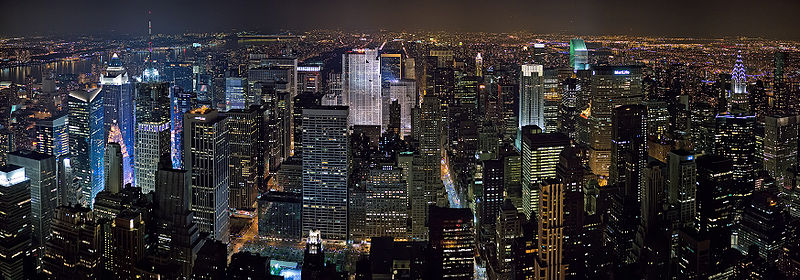
View of the Midtown Manhattan skyline from the Empire State Building.
Architecture
The building form most closely associated with New York City is the skyscraper, that saw New York buildings shift from the low-scale European tradition to the vertical rise of business districts. As of August 2008, New York City has 5,538 highrise buildings, with 50 completed skyscrapers taller than 656 feet (200 m). This is more than any other city in United States, and second in the world behind Hong Kong. Surrounded mostly by water, the city's residential density and high real estate values in commercial districts saw the city amass the largest collection of individual, free-standing office and residential towers in the world.
New York has architecturally significant buildings in a wide range of styles. These include the Woolworth Building (1913), an early gothic revival skyscraper built with massively scaled gothic detailing able to be read from street level several hundred feet below. The 1916 Zoning Resolution required setback in new buildings, and restricted towers to a percentage of the lot size, to allow sunlight to reach the streets below. The Art Deco design of the Chrysler Building (1930), with its tapered top and steel spire, reflected the zoning requirements. The building is considered by many historians and architects to be New York's finest building, with its distinctive ornamentation such as replicas at the corners of the 61st floor of the 1928 Chrysler eagle hood ornaments and V-shaped lighting inserts capped by a steel spire at the tower's crown. A highly influential example of the international style in the United States is the Seagram Building (1957), distinctive for its facade using visible bronze-toned I-beams to evoke the building's structure. The Condé Nast Building (2000) is an important example of green design in American skyscrapers. The character of New York's large residential districts is often defined by the elegant brownstone rowhouses, townhouses, and shabby tenements that were built during a period of rapid expansion from 1870 to 1930. Stone and brick became the city's building materials of choice after the construction of wood-frame houses was limited in the aftermath of the Great Fire of 1835. Unlike Paris, which for centuries was built from its own limestone bedrock, New York has always drawn its building stone from a far-flung network of quarries and its stone buildings have a variety of textures and hues. A distinctive feature of many of the city's buildings is the presence of wooden roof-mounted water towers. In the 1800s, the city required their installation on buildings higher than six stories to prevent the need for excessively high water pressures at lower elevations, which could burst municipal water pipes. Garden apartments became popular during the 1920s in outlying areas, including Jackson Heights in Queens, which became more accessible with expansion of the subway.
Parks
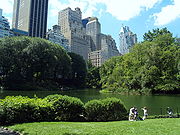
Central Park is the most visited
city park in the United States.
New York City has over 28,000 acres (11,000 ha) of municipal parkland and 14 miles (22 km) of public beaches. This parkland is augmented by thousands of acres of Gateway National Recreation Area, part of the National Park system, that lie within city boundaries. The Jamaica Bay Wildlife Refuge, the only wildlife refuge in the National Park System, alone is over 9,000 acres (3,600 ha) of marsh islands and water taking up most of Jamaica Bay. Manhattan's Central Park, designed by Frederick Law Olmsted and Calvert Vaux, is the most visited city park in the United States with 30 million visitors each year - 10 million more than Lincoln Park in Chicago, which is 2nd. Prospect Park in Brooklyn, also designed by Olmsted and Vaux, has a 90 acre (36 hectare) meadow. Flushing Meadows-Corona Park in Queens, the city's third largest, was the setting for the 1939 World's Fair and 1964 World's Fair.
Boroughs
New York City is composed of five boroughs, an unusual form of government. Each borough is coextensive with a respective county of New York State as shown below. Throughout the boroughs there are hundreds of distinct neighborhoods, many with a definable history and character to call their own. If the boroughs were each independent cities, four of the boroughs (Brooklyn, Queens, Manhattan, and the Bronx) would be among the ten most populous cities in the United States.
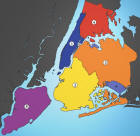
The five boroughs: Manhattan,
Brooklyn, Queens, The Bronx,
Staten Island
* The Bronx (Bronx County: Pop. 1,373,659) is New York City's northernmost borough, the site of Yankee Stadium, home of the New York Yankees, and home to the largest cooperatively owned housing complex in the United States, Co-op City. Except for a small piece of Manhattan known as Marble Hill, the Bronx is the only section of the city that is part of the United States mainland. It is home to the Bronx Zoo, the largest metropolitan zoo in the United States, which spans 265 acres (107.2 ha) and is home to over 6,000 animals. The Bronx is the birthplace of rap and hip hop culture.
* Brooklyn (Kings County: Pop. 2,528,050) is the city's most populous borough and was an independent city until 1898. Brooklyn is known for its cultural, social and ethnic diversity, an independent art scene, distinct neighborhoods and a unique architectural heritage. It is also the only borough outside of Manhattan with a distinct downtown area. The borough features a long beachfront and Coney Island, established in the 1870s as one of the earliest amusement grounds in the country.
* Manhattan (New York County: Pop. 1,620,867) is the most densely populated borough and home to most of the city's skyscrapers, as well as Central Park. The borough is the financial center of the city and contains the headquarters of many major corporations, the United Nations, as well as a number of important universities, and many cultural attractions, including numerous museums, the Broadway theatre district, Greenwich Village, and Madison Square Garden. Manhattan is loosely divided into Lower, Midtown, and Uptown regions. Uptown Manhattan is divided by Central Park into the Upper East Side and the Upper West Side, and above the park is Harlem.
* Queens (Queens County: Pop. 2,270,338) is geographically the largest borough and the most ethnically diverse county in the United States, and may overtake Brooklyn as the city's most populous borough due to its growth. Historically a collection of small towns and villages founded by the Dutch, today the borough is largely residential and middle class. It is the only large county in the United States where the median income among African Americans, approximately $52,000 a year, is higher than that of White Americans. Queens is the site of Citi Field, the home of the New York Mets, and annually hosts the U.S. Open tennis tournament. Additionally, it is home to New York City's two major airports, LaGuardia Airport and John F. Kennedy International Airport.
* Staten Island (Richmond County: Pop. 481,613) is the most suburban in character of the five boroughs. Staten Island is connected to Brooklyn by the Verrazano-Narrows Bridge and to Manhattan via the free Staten Island Ferry. The Staten Island Ferry is one of the most popular tourist attractions in New York City as it provides unsurpassed views of the Statue of Liberty, Ellis Island, and lower Manhattan. Located in central Staten Island, the 25 km² Greenbelt has some 35 miles (56 km) of walking trails and one of the last undisturbed forests in the city. Designated in 1984 to protect the island's natural lands, the Greenbelt encompasses seven city parks. The F.D.R. Boardwalk along South Beach is two and one-half miles long, which is the fourth largest in the world.
Culture and Contemporary Life
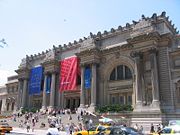
The Metropolitan Museum of Art
is one of the largest museums in
the world
"Culture just seems to be in the air, like part of the weather", the writer Tom Wolfe has said of New York City. Numerous major American cultural movements began in the city, such as the Harlem Renaissance, which established the African-American literary canon in the United States. The city was a center of jazz in the 1940s, abstract expressionism in the 1950s and the birthplace of hip hop in the 1970s. The city's punk and hardcore scenes were influential in the 1970s and 1980s, and the city has long had a flourishing scene for Jewish American literature. Prominent indie rock bands coming out of New York in recent years include The Strokes, Interpol, The Bravery, Scissor Sisters, and They Might Be Giants.
Entertainment and Performing Arts
The city is also important in the American film industry. Manhatta (1920), an early avant-garde film, was filmed in the city. Today, New York City is the second largest center for the film industry in the United States. The city has more than 2,000 arts and cultural organizations and more than 500 art galleries of all sizes. The city government funds the arts with a larger annual budget than the National Endowment for the Arts. Wealthy industrialists in the 19th century built a network of major cultural institutions, such as the famed Carnegie Hall and Metropolitan Museum of Art, that would become internationally established. The advent of electric lighting led to elaborate theatre productions, and in the 1880s New York City theaters on Broadway and along 42nd Street began showcasing a new stage form that came to be known as the Broadway musical.
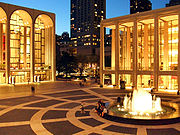
Lincoln Center for the Performing
Arts is home to 12 influential arts
organizations, making it the largest
performing arts complex in the
United States.
Strongly influenced by the city's immigrants, productions such as those of Harrigan and Hart, George M. Cohan and others used song in narratives that often reflected themes of hope and ambition. Today these productions are a mainstay of the New York theatre scene. The city's 39 largest theatres (with more than 500 seats) are collectively known as "Broadway," after the major thoroughfare that crosses the Times Square theatre district. This area is sometimes referred to as The Main Stem, The Great White Way or The Realto.
The Lincoln Center for the Performing Arts, which includes Jazz at Lincoln Center, the Metropolitan Opera, the New York City Opera, the New York Philharmonic, the New York City Ballet, the Vivian Beaumont Theatre, the Juilliard School and Alice Tully Hall, is the largest performing arts center in the United States. Central Park SummerStage presents performances of free plays and music in Central Park and 1,200 free concerts, dance, and theater events across all five boroughs in the summer months.
New York City is considered by many to be the heart of stand-up comedy in the United States.
Cuisine
New York's food culture, influenced by the city's immigrants and large number of dining patrons, is diverse. Eastern European and Italian immigrants have made the city famous for bagels, cheesecake, and New York-style pizza. Some 4,000 mobile food vendors licensed by the city, many immigrant-owned, have made Middle Eastern foods such as falafels and kebabs standbys of contemporary New York street food, although hot dogs and pretzels are still the main street fare. The city is also home to many of the finest haute cuisine restaurants in the United States. New York City's variety of World cuisines is also diverse. Examples could include Italian, French, Spanish, German, Russian, English, Greek, Moroccan, Chinese, Indian, and Japanese cuisines, as well as the diverse indigenous sort.
Media
New York is a global center for the television, advertising, music, newspaper and book publishing industries and is also the largest media market in North America (followed by Los Angeles, Chicago, and Toronto). Some of the city's media conglomerates include Time Warner, the News Corporation, the Hearst Corporation, and Viacom. Seven of the world's top eight global advertising agency networks are headquartered in New York. Three of the "Big Four" record labels are also based in the city, as well as in Los Angeles. One-third of all American independent films are produced in New York. More than 200 newspapers and 350 consumer magazines have an office in the city and the book-publishing industry employs about 25,000 people.
Two of the three national daily newspapers in the United States are New York papers: The Wall Street Journal and The New York Times. Major tabloid newspapers in the city include The New York Daily News and The New York Post, founded in 1801 by Alexander Hamilton. The city also has a major ethnic press, with 270 newspapers and magazines published in more than 40 languages. El Diario La Prensa is New York's largest Spanish-language daily and the oldest in the nation. The New York Amsterdam News, published in Harlem, is a prominent African American newspaper. The Village Voice is the largest alternative newspaper.
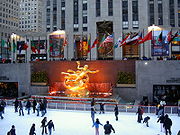
Rockefeller Center is home to
NBC Studios.
The television industry developed in New York and is a significant employer in the city's economy. The four major American broadcast networks, ABC, CBS, FOX and NBC, are all headquartered in New York. Many cable channels are based in the city as well, including MTV, Fox News, HBO and Comedy Central. In 2005, there were more than 100 television shows taped in New York City.
New York is also a major center for non-commercial media. The oldest public-access television channel in the United States is the Manhattan Neighborhood Network, founded in 1971. WNET is the city's major public television station and a primary provider of national PBS programming. WNYC, a public radio station owned by the city until 1997, has the largest public radio audience in the United States. The City of New York operates a public broadcast service, nyctv, that produces several original Emmy Award-winning shows covering music and culture in city neighborhoods, as well as city government.
Accent
The New York City area has a distinctive regional speech pattern called the New York dialect, alternatively known as Brooklynese or New Yorkese. It is often considered to be one of the most recognizable accents within American English. The classic version of this dialect is centered on middle and working class people of European American descent, and the influx of non-European immigrants in recent decades has led to changes in this distinctive dialect.
The traditional New York area accent is non-rhotic, so that the sound does not appear at the end of a syllable or immediately before a consonant; hence the pronunciation of the city as "New Yawk." There is no in words like park (with vowel raised due to the low-back chain shift), butter, or here. In another feature called the low back chain shift, the vowel sound of words like talk, law, cross, and coffee and the often homophonous in core and more are tensed and usually raised more than in General American.
In the most old-fashioned and extreme versions of the New York dialect, the vowel sounds of words like "girl" and of words like "oil" both become a diphthong. This is often misperceived by speakers of other accents as a reversal of the er and oy sounds, so that girl is pronounced "goil" and oil is pronounced "erl"; this leads to the caricature of New Yorkers saying things like "Joizey" (Jersey), "Toidy-Toid Street" (33rd St.) and "terlet" (toilet). The character Archie Bunker from the 1970s sitcom All in the Family was a good example of a speaker who had this feature. This particular speech pattern is no longer very prevalent.
Sports
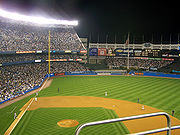
Yankee Stadium was home to
the New York Yankees from 1923
to 2008.
New York City has teams in the four major North American professional sports leagues.
New York is one of the few areas of the United States where baseball, rather than American football, remains the most popular sport. There have been fourteen World Series championship series between New York City teams, in matchups called Subway Series. New York is one of only five metro areas (Chicago, Washington-Baltimore, Los Angeles and the San Francisco Bay Area being the others) to have two baseball teams. The city's two current Major League Baseball teams are the New York Yankees and the New York Mets, who compete in six games every regular season. The Yankees have enjoyed 26 world titles, while the Mets have taken the Series twice. The city also was once home to the New York Giants (now the San Francisco Giants) and the Brooklyn Dodgers (now the Los Angeles Dodgers). Both teams moved to California in 1958. There are also two minor league baseball teams in the city, the Staten Island Yankees and Brooklyn Cyclones.
The city is represented in the National Football League by the New York Jets and New York Giants (officially the New York Football Giants), although both teams play their home games in Giants Stadium in nearby New Jersey.
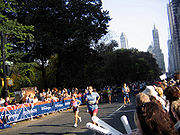
The New York City Marathon is
the largest marathon in the world.
The New York Rangers represent the city in the National Hockey League. Within the metro area are two other teams, the New Jersey Devils and the New York Islanders, who play in Long Island. This is the only instance of any metro area having 3 teams within one of the 4 major North American professional sports leagues.
In Association football, New York is represented by the Major League Soccer side, Red Bull New York. The "Red Bulls" also play their home games at the Giants Stadium in New Jersey.
The city's National Basketball Association team is the New York Knicks and the city's Women's National Basketball Association team is the New York Liberty. Also within the metro area is the NBA team New Jersey Nets. The first national college-level basketball championship, the National Invitation Tournament, was held in New York in 1938 and remains in the city. Rucker Park in Harlem is a celebrated court where many professional athletes play in the summer league.
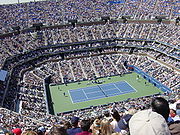
The U.S. Tennis Open (held in
Queens) is the fourth and final
event of the Grand Slam tennis
tournaments.
As a global city, New York supports many events outside these sports. Queens is host of the U.S. Tennis Open, one of the four Grand Slam tournaments. The New York City Marathon is the world's largest, and the 2004-2006 runnings hold the top three places in the marathons with the largest number of finishers, including 37,866 finishers in 2006. The Millrose Games is an annual track and field meet whose featured event is the Wanamaker Mile. Boxing is also a very prominent part of the city's sporting scene, with events like the Amateur Boxing Golden Gloves being held at Madison Square Garden each year.
Many sports are associated with New York's immigrant communities. Stickball, a street version of baseball, was popularized by youths in working class Italian, German, and Irish neighborhoods in the 1930s. Stickball is still commonly played, as a street in The Bronx has been renamed Stickball Blvd. as tribute to New York's most known street sport. In recent years several amateur cricket leagues have emerged with the arrival of immigrants from South Asia and the Caribbean. Street hockey, football, and baseball are also commonly seen being played on the streets of New York. New York City is often called "The World's Biggest Urban Playground," as street sports are commonly played by people of all ages.
Economy
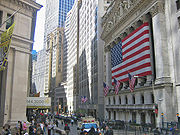
The New York Stock Exchange
on Wall Street is the largest stock
exchange in the world by dollar
volume
New York City is a global hub of international business and commerce and is one of three "command centers" for the world economy (along with London and Tokyo). The city is a major center for finance, insurance, real estate, media and the arts in the United States. The New York metropolitan area had an estimated gross metropolitan product of $1.13 trillion in 2005, the largest regional economy in the United States and second largest city economy in the world. The metropolitan area's economy accounts for the majority of the economic activity in the states of New York and New Jersey. Many major corporations are headquartered in New York City, including 44 Fortune 500 companies. New York is also unique among American cities for its large number of foreign corporations. One out of ten private sector jobs in the city is with a foreign company.
New York City is home to some of the nation's - and the world's - most valuable real estate. 450 Park Avenue was sold on July 2, 2007 for $510 million, about $1,589 per square foot ($17,104/m²), breaking the barely month-old record for an American office building of $1,476 per square foot ($15,887/m²) set in the June 2007 sale of 660 Madison Avenue.
Manhattan had 353.7 million square feet (32,859,805 m²) of office space in 2001.
Midtown Manhattan is the largest central business district in the United States and is home to the highest concentration of the city's skyscrapers. Lower Manhattan is the third largest central business district in the United States, and is home to The New York Stock Exchange, located on Wall Street, and the NASDAQ, representing the world's first and second largest stock exchanges, respectively, when measured by average daily trading volume and overall market capitalization. Financial services account for more than 35% of the city's employment income. Real estate is a major force in the city's economy, as the total value of all New York City property was $802.4 billion in 2006. The Time Warner Center is the property with the highest-listed market value in the city, at $1.1 billion in 2006.
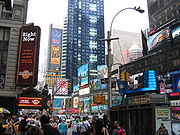
Times Square has been dubbed
"The Crossroads of the World"
The city's television and film industry is the second largest in the country after Hollywood. Creative industries such as new media, advertising, fashion, design and architecture account for a growing share of employment, with New York City possessing a strong competitive advantage in these industries. High-tech industries like bioscience, software development, game design, and internet services are also growing, bolstered by the city's position at the terminus of several transatlantic fiber optic trunk lines. Other important sectors include medical research and technology, non-profit institutions, and universities.
Manufacturing accounts for a large but declining share of employment. Garments, chemicals, metal products, processed foods, and furniture are some of the principal products. The food-processing industry is the most stable major manufacturing sector in the city. Food making is a $5 billion industry that employs more than 19,000 residents, many of them immigrants who speak little English. Chocolate is New York City's leading specialty-food export, with $234 million worth of exports each year.
Tourism is important to New York City, with about 40 million foreign and American tourists visiting each year. Major destinations include the Empire State Building, Ellis Island, Broadway theatre productions, museums such as the Metropolitan Museum of Art, and other tourist attractions including Central Park, Washington Square Park, Rockefeller Center, Times Square, the Bronx Zoo, New York Botanical Garden, luxury shopping along Fifth and Madison Avenues, and events such as the Halloween Parade in Greenwich Village, the Tribeca Film Festival, and free performances in Central Park at Summerstage. The Statue of Liberty is a major tourist attraction and one of the most recognizable icons of the United States. Many of the city's ethnic enclaves, such as Jackson Heights, Flushing, and Brighton Beach are major shopping destinations for first and second generation Americans up and down the East Coast.
Demographics
New York is the most populous city in the United States, with an estimated 2007 population of 8,274,527 (up from 7.3 million in 1990). This amounts to about 40% of New York State's population and a similar percentage of the metropolitan regional population. Over the last decade the city's population has been increasing and demographers estimate New York's population will reach between 9.2 and 9.5 million by 2030.
New York's two key demographic features are its population density and cultural diversity. The city's population density of 26,403 people per square mile (10,194/km²) makes it the most densely populated American municipality with a population above 100,000. Manhattan's population density is 66,940 people per square mile (25,846/km²), highest of any county in the United States.
New York City is exceptionally diverse. Throughout its history the city has been a major point of entry for immigrants; the term melting pot was first coined to describe densely populated immigrant neighborhoods on the Lower East Side. Today, 36% of the city's population is foreign-born. Among American cities, this proportion is exceeded only by Los Angeles and Miami. While the immigrant communities in those cities are dominated by a few nationalities, in New York no single country or region of origin dominates. The ten largest countries of origin for modern immigration are the Dominican Republic, China, Jamaica, Guyana, Mexico, Ecuador, Haiti, Trinidad and Tobago, Colombia, and Russia. About 170 languages are spoken in the city.
The New York metropolitan area is home to the largest Jewish community outside Israel; Tel Aviv proper (non-metro/within municipal limits) has a smaller population than the Jewish population of New York City proper, making New York the largest Jewish community in the world. About 12% of New Yorkers are Jewish or of Jewish descent and roots. It is also home to nearly a quarter of the nation's Indian Americans, and the largest African American community of any city in the United States.
The five largest ethnic groups as of the 2005 census estimates are: Puerto Ricans, Italians, West Indians, Dominicans and Chinese. The Puerto Rican population of New York City is the largest outside of Puerto Rico. Italians emigrated to the city in large numbers in the early twentieth century. The Irish, the sixth largest ethnic group, also have a notable presence; one in 50 New Yorkers of European origin carry a distinctive genetic signature on their Y chromosomes inherited from Niall of the Nine Hostages, an Irish high king of the fifth century A.D.
New York City has a high degree of income disparity. In 2005 the median household income in the wealthiest census tract was $188,697, while in the poorest it was $9,320. The disparity is driven by wage growth in high income brackets, while wages have stagnated for middle and lower income brackets. In 2006 the average weekly wage in Manhattan was $1,453, the highest and fastest growing among the largest counties in the United States. The borough is also experiencing a baby boom that is unique among American cities. Since 2000, the number of children under age 5 living in Manhattan grew by more than 32%.
Home ownership in New York City is about 33%, much lower than the national average of 69%. Rental vacancy is usually between 3% and 4.5%, well below the 5% threshold defined to be a housing emergency and used to justify the continuation of rent control and rent stabilization. About 33% of rental units are rent-stabilized. Finding housing, particularly affordable housing, in New York City can be more than challenging.
Government
Since its consolidation in 1898, New York City has been a metropolitan municipality with a "strong" mayor-council form of government. The government of New York is more centralized than that of most other U.S. cities. In New York City, the central government is responsible for public education, correctional institutions, libraries, public safety, recreational facilities, sanitation, water supply and welfare services. The mayor and councillors are elected to four-year terms. The New York City Council is a unicameral body consisting of 51 Council members whose districts are defined by geographic population boundaries. The mayor and councilors are limited to two four-year terms.
The mayor is Michael Bloomberg, a former Democrat and current independent elected as a Republican in 2001 and re-elected in 2005 with 59% of the vote. He is known for taking control of the city's education system from the state, rezoning and economic development, sound fiscal management, and aggressive public health policy. In his second term he has made school reform, poverty reduction, and strict gun control central priorities of his administration. Together with Boston mayor Thomas Menino, in 2006 he founded the Mayors Against Illegal Guns Coalition, an organization with the goal of "making the public safer by getting illegal guns off the streets." The Democratic Party holds the majority of public offices. 66% of registered voters in the city are Democrats. New York City has not been carried by a Republican in a statewide or presidential election since 1924. Party platforms center on affordable housing, education and economic development, and labor politics are of importance in the city.
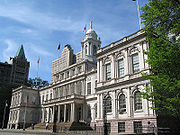
New York City Hall is the oldest
City Hall in the United States that still
houses its original governmental
functions.
New York is the most important source of political fundraising in the United States, as four of the top five zip codes in the nation for political contributions are in Manhattan. The top zip code, 10021 on the Upper East Side, generated the most money for the 2004 presidential campaigns of both George W. Bush and John Kerry. The city has a strong imbalance of payments with the national and state governments. It receives 83 cents in services for every $1 it sends to the federal government in taxes (or annually sends $11.4 billion more than it receives back). The city also sends an additional $11 billion more each year to the state of New York than it receives back.
Located near City Hall are the courthouse for the United States District Court for the Southern District of New York and United States Court of Appeals for the Second Circuit, and the Jacob K. Javits Federal Building. Manhattan also hosts the NY Appellate Division, First Department. Brooklyn hosts the United States District Court for the Eastern District of New York, and NY Appellate Division, Second Department. As with any county, each Borough has a branch of the New York Supreme Court and other New York State courts.
Crime
Since 2005 the city has had the lowest crime rate among the 25 largest U.S. cities, having become significantly safer after a spike in crime in the 1980s and early 1990s from the crack epidemic that impacted many neighborhoods. By 2002, New York City had about the same crime rate as Provo, Utah and was ranked 197th in overall crime among the 216 U.S. cities with populations greater than 100,000. Violent crime in New York City decreased more than 75% from 1993 to 2005 and continued decreasing during periods when the nation as a whole saw increases. In 2005 the homicide rate was at its lowest level since 1963, and in 2007 the city recorded fewer than 500 homicides for the first time ever since crime statistics were first published in 1963.
Sociologists and criminologists have not reached consensus on what explains the dramatic decrease in the city's crime rate. Some attribute the phenomenon to new tactics used by the New York City Police Department, including its use of CompStat and the broken windows theory. Others cite the end of the crack epidemic and demographic changes.
Organized crime has long been associated with New York City, beginning with the Forty Thieves and the Roach Guards in the Five Points in the 1820s. The 20th century saw a rise in the Mafia dominated by the Five Families. Gangs including the Black Spades also grew in the late 20th century.
Education
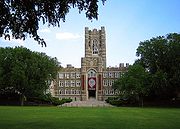
Fordham University's Keating Hall
in The Bronx.
The city's public school system, managed by the New York City Department of Education, is the largest in the United States. About 1.1 million students are taught in more than 1,200 separate primary and secondary schools. There are approximately 900 additional privately run secular and religious schools in the city, including some of the most prestigious private schools in the United States. Though it is not often thought of as a college town, there are about 594,000 university students in New York City, the highest number of any city in the United States. In 2005, three out of five Manhattan residents were college graduates and one out of four had advanced degrees, forming one of the highest concentrations of highly educated people in any American city. Public postsecondary education is provided by the City University of New York, the nation's third-largest public university system, and the Fashion Institute of Technology, part of the State University of New York. New York City is also home to such notable private universities as Barnard College, Columbia University, Cooper Union, Fordham University, New York University, The New School, and Yeshiva University. The city has dozens of other smaller private colleges and universities, including many religious and special-purpose institutions, such as St. John's University, The Juilliard School and The School of Visual Arts.
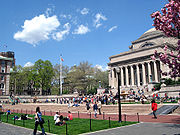
Columbia University's Low
Memorial Library.
Much of the scientific research in the city is done in medicine and the life sciences. New York City has the most post-graduate life sciences degrees awarded annually in the United States, 40,000 licensed physicians, and 127 Nobel laureates with roots in local institutions. The city receives the second-highest amount of annual funding from the National Institutes of Health among all U.S. cities. Major biomedical research institutions include Memorial Sloan-Kettering Cancer Center, Rockefeller University, SUNY Downstate Medical Center, Albert Einstein College of Medicine, Mount Sinai School of Medicine and Weill Cornell Medical College.
The New York Public Library, which has the largest collection of any public library system in the country, serves Manhattan, The Bronx, and Staten Island. Queens is served by the Queens Borough Public Library, which is the nation's second largest public library system, and Brooklyn Public Library serves Brooklyn. The New York Public Library has several research libraries, including the Schomburg Center for Research in Black Culture.
New York City also features many of the most elite and exclusive private schools in the country. These schools include Brearley School, Dalton School, Spence School, The Chapin School, Nightingale-Bamford School, and Convent of the Sacred Heart on the Upper East Side of Manhattan; Collegiate School and Trinity School on the Upper West Side of Manhattan; Horace Mann School, Ethical Culture Fieldston School, and Riverdale Country School in Riverdale, Bronx; and Saint Ann's School in Brooklyn Heights, Brooklyn. Some of New York City's renowned public secondary schools, often considered the best in the nation, include: Hunter College High School, Stuyvesant High School, The Bronx High School of Science, Brooklyn Technical High School, Bard High School Early College, Townsend Harris High School, and LaGuardia High School. The city is home to the largest Roman Catholic high school in the U.S., St. Francis Preparatory School in Fresh Meadows, Queens, and the only official Italian American school in the country, the La Scuola d'Italia on the Upper East Side of Manhattan.
Transportation
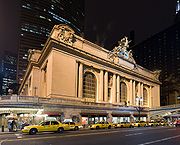
New York City is home to the
two busiest rail stations in the U.S.,
including Grand Central Terminal
(seen here).
Public transit is overwhelmingly the dominant form of travel for New Yorkers. About one in every three users of mass transit in the United States and two-thirds of the nation's rail riders live in New York and its suburbs. This is in contrast to the rest of the country, where about 90% of commuters drive automobiles to their workplace. New York is the only city in the United States where more than half of all households do not own a car (in Manhattan, more than 75% of residents do not own a car; nationally, the percentage is 8%). According to the US Census Bureau, New York City residents spend an average of 38.4 minutes per day getting to work, the longest commute time in the nation among large cities.
New York City is served by Amtrak, which uses Pennsylvania Station. Amtrak provides connections to Boston, Philadelphia, and Washington, D.C.
The New York City Subway is the largest rapid transit system in the world when measured by the number of stations in operation, with 468. It is the third-largest when measured by annual ridership (1.5 billion passenger trips in 2006). New York's subway is also notable because nearly all of the system remains open 24 hours per day (though in some cases with significant differences in routings from the daytime network), in contrast to the overnight shutdown common to systems in most cities, including London, Paris, Washington, DC, Madrid and Tokyo. The transportation system in New York City is extensive and complex. It includes the longest suspension bridge in North America, the world's first mechanically ventilated vehicular tunnel, more than 12,000 yellow cabs, an aerial tramway that transports commuters between Roosevelt Island and Manhattan, and a ferry system connecting Manhattan to various locales within and outside the city. The busiest ferry in the United States is the Staten Island Ferry, which annually carries over 19 million passengers on the 5.2 mile (8.4 km) run between Staten Island and Lower Manhattan. The "PATH" train (Port Authority Trans-Hudson) is a subway system going under the Hudson River, linking the New York City subway to points in northeast New Jersey.
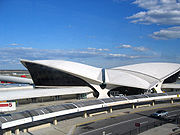
The TWA Flight Center Building at
John F. Kennedy International
Airport.
New York City's public bus fleet and commuter rail network are the largest in North America. The rail network, which connects the suburbs in the tri-state region to the city, has more than 250 stations and 20 rail lines. The commuter rail system converges at Grand Central Terminal and Pennsylvania Station.
New York City is the top international air passenger gateway to the United States. The area is served by three major airports, John F. Kennedy International, Newark Liberty International and LaGuardia, with plans for a fourth airport, Stewart International Airport near Newburgh, NY, to be taken over and enlarged by the Port Authority of New York and New Jersey (which administers the other three airports), as a "reliever" airport to help cope with increasing passenger volume. 100 million travelers used the three airports in 2005 and the city's airspace is the busiest in the nation. Outbound international travel from JFK and Newark accounted for about a quarter of all U.S. travelers who went overseas in 2004.
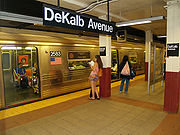
The New York City Subway is
the world's largest mass transit
system by number of stations and
mileage of track
New York's high rate of public transit use, 120,000 daily cyclists and many pedestrian commuters makes it the most energy-efficient major city in the United States. Walk and bicycle modes of travel account for 21% of all modes for trips in the city; nationally the rate for metro regions is about 8%.
To complement New York's vast mass transit network, the city also has an extensive web of expressways and parkways, that link New York City to northern New Jersey, Westchester County, Long Island, and southwest Connecticut through various bridges and tunnels. Because these highways serve millions of suburban residents who commute into New York, it is quite common for motorists to be stranded for hours in traffic jams that are a daily occurrence, particularly during rush hour. The George Washington Bridge is considered one of the world's busiest bridges in terms of vehicle traffic.
Despite New York's reliance on public transit, roads are a defining feature of the city. Manhattan's street grid plan greatly influenced the city's physical development. Several
of the city's streets and avenues, like Broadway, Wall Street and Madison Avenue are also used as shorthand in the American vernacular for national industries located there: the theater, finance, and
advertising organizations, respectively.
New York Information Topics


