Niagara Falls Information
New York Information Topics
Home > Articles > Niagara Falls Information
From Wikipedia, the free encyclopedia
Niagara Falls
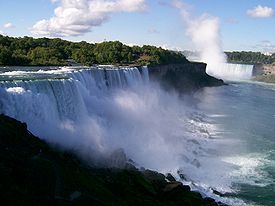 |
| View of Niagara Falls from the official viewing deck. |
The Niagara Falls are massive waterfalls on the Niagara River, straddling the international border separating the Canadian province of Ontario and the U.S. state of New York. The falls are 17 miles (27 km) north-northwest of Buffalo, New York, 75 miles (120 km) south-southeast of Toronto, Ontario, between the twin cities of Niagara Falls, Ontario, and Niagara Falls, New York.
Niagara Falls is composed of two major sections separated by Goat Island: Horseshoe Falls, on the Canadian side of the border and American Falls on the United States side. The smaller Bridal Veil Falls also is located on the American side, separated from the main falls by Luna Island. Niagara Falls were formed when glaciers receded at the end of the Wisconsin glaciation (the last ice age), and water from the newly-formed Great Lakes carved a path through the Niagara Escarpment en route to the Atlantic Ocean. While not exceptionally high, the Niagara Falls are very wide. More than six million cubic feet (168,000 m³) of water falls over the crest line every minute in high flow, and almost 4 million cubic feet (110,000 m³) on average. It is the most powerful waterfall in North America.
The Niagara Falls are renowned both for their beauty and as a valuable source of hydroelectric power. Managing the balance between recreational, commercial, and industrial uses has been a challenge for the stewards of the falls since the 1800s.
Characteristics
|
|
| Niagara Falls, as viewed from Canada, with the American and Bridal Veil falls on the left, and Horseshoe Falls on the right. |
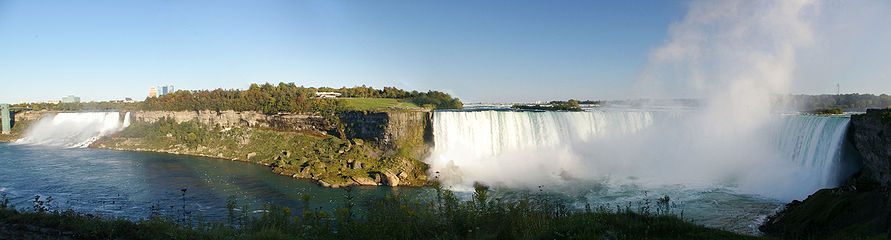
Niagara Falls is divided into the Horseshoe Falls and the American Falls. The Horseshoe Falls drop about 173 feet (53 m), the height of the American Falls varies between 70-100 feet (21 m) because of the presence of giant boulders at its base. The larger Horseshoe Falls are about 2,600 feet (792 m) wide, while the American Falls are 1,060 feet (323 m) wide.
|
|
| Aerial view of Niagara Falls, with American Falls on the left and the Horseshoe Falls on the right |
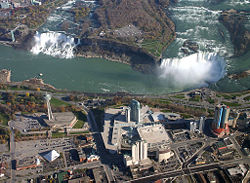
The volume of water approaching the falls during peak flow season may sometimes be as much as 202,000 cubic feet per second (5,720 m³/s). By comparison Africa's spectacular Victoria Falls has over 19 million cubic feet (546,000 m³) of water falling over its crest line each minute during the peak of the wet season (320,000 cu ft/9,100 m³ per second). Since the flow is a direct function of the Lake Erie water elevation, it typically peaks in late spring or early summer. During the summer months, 100,000 cubic feet per second (2,832 m³/s) of water actually traverses the Falls, some 90% of which goes over the Horseshoe Falls, while the balance is diverted to hydroelectric facilities. This is accomplished by employing a weir with movable gates upstream from the Horseshoe Falls. The Falls flow is further halved at night, and during the low tourist season in the winter, remains a flat 50,000 cubic feet per second (1,416 m³/s). Water diversion is regulated by the 1950 Niagara Treaty and is administered by the International Niagara Board of Control (IJC). Viewpoints on the American shore generally are astride or behind the falls. The falls face directly toward the Canadian shore. Thus, the most complete views of Niagara Falls are available from the Canadian side of the river. It is about a two hour drive from Toronto.
Geology
The features that became Niagara Falls were created by the Wisconsin glaciation, about 10,000 years ago. The same forces also created the North American Great Lakes and the Niagara River. All were dug by a continental ice sheet that drove through the area like a giant bulldozer, deepening some river channels to make lakes, and damming others with debris. Scientists believe that there is an old valley, buried by glacial drift, at the approximate location of the present Welland Canal.
|
|
| Panoramic American view of the Horseshoe Falls |

When the ice melted, the upper Great Lakes emptied into the Niagara River, which followed the rearranged topography across the Niagara Escarpment. In time, the river cut a gorge through the north facing cliff, or cuesta. Because of the interactions of three major rock formations, the rocky bed did not erode evenly. The top rock formation was composed of erosion-resistant limestone and Lockport dolostone. That hard layer of stone eroded more slowly than the underlying materials. The aerial photo clearly shows the hard caprock, the Lockport Formation (Middle Silurian), which underlies the rapids above the Falls, and approximately the upper third of the high gorge wall.
Immediately below the hard-rock formation, comprising about two thirds of the cliff, lay the weaker, softer, sloping Rochester Formation (Lower Silurian). This formation was composed mainly of shale, though it has some thin limestone layers. It also contains ancient fossils. In time, the river eroded the soft layer that supported the hard layers, undercutting the hard caprock, which gave way in great chunks. This process repeated countless times, eventually carving out the Falls.
Submerged in the river in the lower valley, hidden from view, is the Queenston Formation (Upper Ordovician), which is composed of shales and fine sandstones. All three formations were laid down in an ancient sea, their differences of character deriving from changing conditions within that sea.
The original Niagara Falls were near the sites of present-day Queenston, Ontario, and Lewiston, New York, but erosion of their crest has caused the waterfalls to retreat approximately 6.8 miles or 11 kilometers southward. The Horseshoe Falls, which are approximately 2,600 feet (790 m) wide, has also changed its shape through the process of erosion It has changed from a once small arch, to a horseshoe bend, to the present day gigantic inverted V. Just upstream from the Falls' current location, Goat Island splits the course of the Niagara River, resulting in the separation of the Canadian Horseshoe Falls to the west from the American and Bridal Veil Falls to the east. Engineering has slowed erosion and recession.[citation needed]
History
There are differing theories as to the origin of the name of the falls. According to Iroquoian scholar Bruce Trigger, "Niagara" is derived from the name given to a branch of the locally residing native Neutral Confederacy, who are described as being called the "Niagagarega" people on several late 17th century French maps of the area.
A number of figures have been suggested as first circulating an eyewitness description of Niagara Falls. Frenchman Samuel de Champlain visited the area as early as 1604 during his exploration of Canada, and members of his party reported to him the spectacular waterfalls, which he described in his journals. Finnish-Swedish naturalist Pehr Kalm explored the area in the early 1700s and wrote of the experience. The consensus honoree is Belgian Father Louis Hennepin, who observed and described the Falls in 1677, earlier than Kalm, after traveling with explorer René Robert Cavelier, Sieur de la Salle, thus bringing the Falls to the attention of Europeans. Further complicating matters, there is credible evidence that French Jesuit Reverend Paul Ragueneau visited the Falls some 35 years before Hennepin's visit, while working among the Huron First Nation in Canada. Jean de Brébeuf also may have visited the Falls, while spending time with the Neutral Nation.
During the 18th century tourism became popular, and by mid-century, it was the area's main industry. Napoleon Bonaparte's brother Jérôme visited with his bride in the early 19th century. In 1837 during the Caroline affair a rebel supply ship, the Caroline was burned and sent over the Falls. Demand for passage over the Niagara River led in 1848 to the building of a footbridge and then Charles Ellet's Niagara Suspension Bridge. This was supplanted by German-born John Augustus Roebling's Niagara Falls Suspension Bridge in 1855. After the American Civil War, the New York Central railroad publicized Niagara Falls as a focus of pleasure and honeymoon visits. With increased railroad traffic, in 1886, Leffert Buck replaced Roebling's wood and stone bridge with the predominantly steel bridge that still carries trains over the Niagara River today. The first steel archway bridge near the Falls was completed in 1897. Known today as the Whirlpool Rapids Bridge, it carries vehicles, trains, and pedestrians between Canada (through Canadian Customs Border Control) and the U.S.A. just below the Falls. In 1941 the Niagara Falls Bridge Commission completed the third current crossing in the immediate area of Niagara Falls with the Rainbow Bridge, carrying both pedestrian and vehicular traffic between the two countries and Canadian and U.S. customs for each country.
After the First World War, tourism boomed again as automobiles made getting to the Falls much easier. The story of Niagara Falls in the 20th century is largely that of efforts to harness the energy of the Falls for hydroelectric power, and to control the development on both sides that threaten the area's natural beauty.
Impact on industry and commerce
Power
|
|
| American Falls (large waterfall on the left) and Bridal Veil Falls (smaller waterfall on the right) |
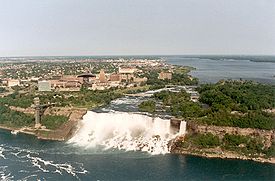
The enormous energy of Niagara Falls has long been recognized as a potential source of power. The first known effort to harness the waters was in 1759, when Daniel Joncaire built a small canal above the Falls to power his sawmill. Augustus and Peter Porter purchased this area and all of American Falls in 1805 from the New York state government, and enlarged the original canal to provide hydraulic power for their gristmill and tannery. In 1853, the Niagara Falls Hydraulic Power and Mining Company was chartered, which eventually constructed the canals which would be used to generate electricity. In 1881, under the leadership of Jacob Schoellkopf, enough power was produced to send direct current to illuminate both the Falls themselves and nearby Niagara Falls village.
When Nikola Tesla, for whom a memorial was later built at Niagara Falls, NY (USA), invented the three-phase system of alternating current power transmission, distant transfer of electricity became possible. In 1883, the Niagara Falls Power Company, a descendant of Schoellkopf's firm, hired George Westinghouse to design a system to generate alternating current. The world's first AC power generating and transmission plant was built at Ames, below Telluride, Colorado, by Westinghouse, Tesla and L.L. Nunn and proved effective by transmitting AC two miles at a loss of less than 5%. Four years later, by 1896, with financing from moguls like J.P. Morgan, John Jacob Astor IV, and the Vanderbilts, they had constructed giant underground conduits leading to turbines generating upwards of 100,000 horsepower (75 MW), and were sending power as far as Buffalo, twenty miles (32 km) away. The original design for these power generating and transmission plants were created by the Swiss firm Faesch & Piccard. Private companies on the Canadian side also began to harness the energy of the Falls. The Government of the province of Ontario, Canada eventually brought power transmission operations under public control in 1906, distributing Niagara's energy to various parts of the Canadian province. Currently between 50% and 75% of the Niagara River's flow is diverted via four huge tunnels that arise far upstream from the waterfalls. The water then passes through hydroelectric turbines that supply power to nearby areas of the Canada and the USA before returning to the river well past the Falls.
The most powerful hydroelectric stations on the Niagara River are Sir Adam Beck 1 and 2 on the Canadian side, and the Robert Moses Niagara Power Plant and the Lewiston Pump Generating Plant on the American side. All together, Niagara's generating stations can produce about 4.4 GW of power. The engineer credited with design of the system is Edward Dean Adams.
In August 2005 Ontario Power Generation, which is responsible for the Sir Adam Beck stations, announced plans to build a new 6½ mile (10.4 km) tunnel to tap water from farther up the Niagara river than is possible with the existing arrangement. The project is expected to be completed in 2009, and will increase Sir Adam Beck's output by about 182 MW (4.2%).
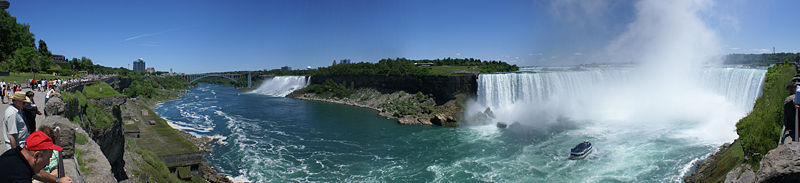 |
| Panoramic view of American and Horseshoe Falls from Canada. |
Transport
Ships can bypass Niagara Falls by means of the Welland Canal, which was improved and incorporated into the Saint Lawrence Seaway in the 1960s. While the seaway diverted water traffic from nearby Buffalo and led to the demise of its steel and grain mills, other industries in the Niagara River valley flourished with the help of the electric power produced by the river until the 1970s. Since then the region has declined economically.
The cities of Niagara Falls, Ontario, Canada and Niagara Falls, New York, USA are connected by three bridges: the Rainbow Bridge, just downriver from the Falls, which affords the closest view of the Falls and is open to non-commercial vehicle traffic and pedestrians; the Whirlpool Rapids Bridge, one mile (1.5 km) down from the Rainbow bridge and the oldest bridge over the Niagara river. The newest bridge, the Lewiston-Queenston Bridge, is located near the escarpment. Nearby Niagara Falls International Airport and Buffalo Niagara International Airport were named after the waterfall, as were Niagara University, countless local businesses, and even an asteroid.
Preservation efforts
Niagara Falls has long been a source of inspiration for explorers, travelers, artists, authors, filmmakers, residents and visitors, few of whom realize that the falls nearly were devoted exclusively to industrial and commercial use. In the 1870s, sightseers had limited access to Niagara Falls and often had to pay merely for a glimpse, and industrialization threatened to carve up Goat Island to power expanding commercial development. Other industrial encroachments and lack of public access led to a conservation movement in the U.S. known as Free Niagara, led by such notables as Hudson River school artist Frederic Edwin Church, landscape designer Frederick Law Olmsted, and architect Henry Hobson Richardson. Church approached Lord Dufferin, governor-general of Canada, with a proposal for international discussions on establishment of a public park.
Goat Island was one of the inspirations for the American side of the effort. William Dorsheimer, moved by the scene from the island, brought Olmsted to Buffalo in 1868 to design a city park system and helped promote Olmstead's career. Later, in 1879, the New York state legislature commissioned Olmsted and James T. Gardner to survey the falls and to create the single most important document in the Niagara preservation movement, a Special Report on the preservation of Niagara Falls. The report advocated for State purchase, restoration and preservation through public ownership of the scenic lands surrounding Niagara Falls. Restoring the former beauty of the falls was described in the report as a "sacred obligation to mankind." In 1883, Governor Grover Cleveland drafted legislation authorizing acquisition of lands for a state reservation at Niagara and The Niagara Falls Association, a private citizens group founded in 1882, mounted a massive letter writing campaign and petition drive in support of the park. Professor Charles Eliot Norton and Olmsted were among the leaders of the public campaign, while New York Governor Alonzo Cornell opposed.
|
|
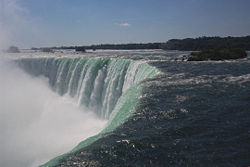
| A closer view of the Horseshoe (Canadian) Falls in the early morning. |
Preservationists' efforts were rewarded on April 30, 1885, when Governor David B. Hill signed legislation creating the Niagara Reservation, New York's first state park. New York state began to purchase land from developers, under the charter of the Niagara Reservation State Park. In the same year, the province of Ontario established the Queen Victoria Niagara Falls Park for the same purpose. On the Canadian side, the Niagara Parks Commission governs land usage along the entire course of the Niagara River, from Lake Erie to Lake Ontario.
In 1887, Olmsted and Calvert Vaux issued a supplemental report detailing plans to restore the falls. Their intent was "to restore and conserve the natural surroundings of the Falls of Niagara, rather than to attempt to add anything thereto", and the report anticipated fundamental questions. How would preservationists provide access without destroying the beauty of the falls? How would they restore natural landscapes damaged by man? They planned a park with scenic roadways, paths and a few shelters designed to protect the landscape while allowing large numbers of visitors to enjoy the falls. Commemorative statues, shops, restaurants, and a 1959 glass and metal observation tower were added later. Preservationists continue to strive to strike a balance between Olmsted's idyllic vision, and the realities of administering a popular scenic attraction.
Preservation efforts continued well into the 20th century. J. Horace McFarland, the Sierra Club, and the Appalachian Mountain Club persuaded the United States Congress in 1906 to enact legislation to preserve the Falls by regulating the waters of Niagara River. The act sought, in cooperation with the Canadian government, to restrict diversion of water, and a treaty resulted in 1909 that limited the total amount of water diverted from the Falls by both nations to approximately 56,000 cubic feet (1,600 m³) per second. That limitation remained in effect until 1950.
|
|
| American Falls "shut off" during erosion control efforts in 1969. |
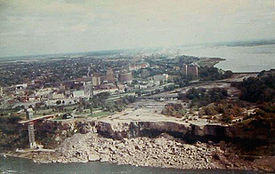
Erosion control efforts also have been important. Underwater weirs redirect the most damaging currents, and top of the falls has been strengthened. In June 1969, for example, the Niagara River was entirely diverted from the American Falls for several months through construction of a temporary rock and earth dam (clearly visible in the photo at right). While the Horseshoe Falls absorbed the extra flow, the U.S. Army Corps of Engineers studied the riverbed and mechanically bolted faults which would otherwise have hastened the retreat of the American Falls. A plan to remove the huge mound of talus deposited in 1954 was abandoned owing to cost, and in November 1969, the temporary dam was dynamited, restoring flow to the American Falls. Even after these undertakings, Luna Island, the small piece of land between the main waterfall and the Bridal Veil, remained off limits to the public for years owing to fears that it was unstable and could collapse into the gorge at any time.
Not far away from the Falls, commercial interests have prevailed. Recent construction of several tall buildings (most of them hotels) on the Canadian side resulted in a remarkable alteration and urbanisation of the landscape. It has also caused the airflow over the Falls to change direction. The result is that the viewing areas on the Canadian side are now often obscured by a layer of mist.
In entertainment and popular culture
Over The Falls
In October 1829, Sam Patch, who called himself "the Yankee Leapster" jumped from a high tower into the gorge below the falls and survived; this began a long tradition of daredevils trying to go over the Falls. On October 24, 1901, 63-year-old Michigan school teacher Annie Edson Taylor was the first person to go over the Falls in a barrel as a publicity stunt; she survived, bleeding, but virtually unharmed. Soon after exiting the barrel, she said, "No one should ever try that again." Unfortunately, the fortune she hoped to make from a later lecture tour was never realized, as her manager was a con-man who took everything she owned. Previous to Taylor's own attempt, on October 19 a domestic cat named Iagara was sent over the Horseshoe Falls in her barrel to test its strength. Contrary to rumours at the time, the cat survived the plunge unharmed and later was posed with Taylor in photographs. Since Taylor's historic ride, 14 other people have intentionally gone over the Falls in or on a device, despite her advice. Some have survived unharmed, but others have drowned or been severely injured. Survivors of such stunts face charges and stiff fines, as it is illegal, on both sides of the border, to attempt to go over the Falls.
In 1918, there was a near disaster when a barge, known locally as the Niagara Scow, working up-river broke its tow, and almost plunged over the falls. Fortunately, the vessel grounded on rocks just short of the falls.
Other daredevils have made crossing the Falls their goal, starting with the successful passage by Jean François "Blondin" Gravelet in 1859. These tightrope walkers drew huge crowds to witness their exploits. Their wires ran across the gorge, near the current Rainbow Bridge, not over the waterfall itself. Among the many was Ontario's William Hunt, who billed himself as "Signor Fanini" and competed with Blondin in performing outrageous stunts over the gorge. Englishman Captain Matthew Webb, the first man to swim the English Channel, drowned in 1883 after unsuccessfully trying to swim the rapids down river from the Falls.
In what some called the "Miracle at Niagara", Roger Woodward, a seven-year-old American boy, was swept over the Horseshoe Falls protected only by a life vest on July 9, 1960, as two tourists pulled his 17-year-old sister Deanne from the river only 20 feet (6 m) from the lip of the Horseshoe Falls at Goat Island. Minutes later, Roger was plucked from the roiling plunge pool beneath the Horseshoe Falls after grabbing a life ring thrown to him by the crew of the Maid of the Mist boat. His survival, which no one thought possible, made news throughout the world.
On July 2, 1984, Canadian Karel Soucek from Hamilton, Ontario successfully plunged over the Horseshoe Falls in a barrel with only minor injuries. Soucek was fined $500 for performing the stunt without a license. In 1985, he was fatally injured while attempting to re-create the Niagara drop at the Houston Astrodome. His aim was to climb into a barrel hoisted to the rafters of the Astrodome and to drop 180 feet (55 m) into a water tank on the floor. After his barrel released prematurely, it hit the side of the tank and he died the next day from his injuries.
In August 1985, Steve Trotter, an aspiring stunt man from Rhode Island, became the youngest person ever (age 22) and the first American in 25 years to go over the Falls in a barrel. Ten years later, Trotter went over the Falls again, becoming the second person to go over the Falls twice and survive. It was also the second-ever "duo"; Lori Martin joined Trotter for the barrel ride over the Falls. They survived the fall but their barrel became stuck at the bottom of the falls, requiring a rescue.
On September 28, 1989 Niagara's own Peter DeBernardi (42) and Jeffery James Petkovich (25) became the first "team" to successfully make it over the falls in a two person barrel. The stunt was conceived by Peter DeBenardi, who wanted to discourage youth from following in his path of addictive drug use. Peter was also trying to leave a legacy and discourage his son Kyle Lahey DeBernardi (2) from using addictive drugs. Peter DeBernardi had originally expected to have a different passenger, however Peter's original partner backed out of the plans and Peter was forced to look for an alternative, Jeffery Petkovich agreed to the stunt. Peter claims he spent an estimated $30,000 making his barrel including; harness's steel and fiberglass construction with steel bands and viewing ports. Peter's Barrel also included a radio for music and news reports, rudders to help steer the barrel through the falls, oxygen, and a well protected video camera to record the journey over the falls. They emerged shortly after going over with minor injuries and were charged with performing an illegal stunt under the Niagara Parks Act.
|
|
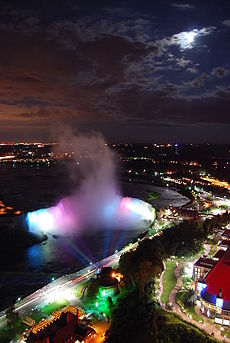
| Niagara Falls at night. |
On September 27, 1993 John "David" Munday, of Caistor Centre, Ontario, became the first person to survive going over the falls twice.
Kirk Jones of Canton, Michigan became the first known person to survive a plunge over the Horseshoe Falls without a flotation device on October 20, 2003. While it is still not known whether Jones was determined to commit suicide, he survived the 16-story fall with only battered ribs, scrapes, and bruises.
A newspaper account in the late 19th century does cite a bulldog believed to have successfully, though accidentally, endured the passage.
All "over the Falls" survivors have passed over the Horseshoe Falls, where there are fewer boulders, and the current can "throw" a person farther away from the brink to avoid them.
Movies and television
Already a huge tourist attraction and favorite spot for honeymooners, Niagara Falls visits rose sharply in 1953 after the release of Niagara, a movie starring Marilyn Monroe and Joseph Cotten. Later in the 20th century, the Falls was a featured location in 1980s movie Superman II, and was itself the subject of a popular IMAX movie, Niagara: Miracles, Myths and Magic. . Much of the episode Return of the Technodrome in the 1987 Teenage Mutant Ninja Turtles cartoon series take place near the Niagara Falls and its hydroelectric plant. Illusionist David Copperfield performed a trick in which he appeared to travel over the Horseshoe Falls in 1990. The Falls, or more particularly, the tourist-supported complex near the Falls, was the setting of the short-lived Canadian television show Wonderfalls in early 2004. More recently, location footage of the Falls was shot in October 2006 to portray "World's End" of the movie Pirates of the Caribbean: At World's End.
Tourism
Peak numbers of visitors occur in the summertime, when Niagara Falls are both a daytime and evening attraction. From the Canadian side, floodlights illuminate both sides of the Falls for several hours after dark (until midnight). The number of visitors in 2008 is expected to total 20 million and by 2009, the annual rate is expected to top 28 million tourists a year. The oldest and best known tourist attraction at Niagara Falls is the Maid of the Mist boat cruise, named for an ancient Ongiara Indian mythical character, which has carried passengers into the whirlpools beneath the Falls since 1846. Cruise boats operate from boat docks on both sides of the falls.
American side
From the U.S. side, the American Falls can be viewed from walkways along Prospect Point Park, which also features the Prospect Point Park observation tower and a boat dock for the Maid of the Mist. Goat Island offers more views of the falls and is accessible by foot and automobile traffic by bridge above the American Falls. From Goat Island, the Cave of the Winds is accessible by elevator and leads hikers to a point beneath Bridal Veil Falls. Also on Goat Island are the Three Sisters Islands, the Power Portal where a huge statue of Nikola Tesla can be seen, and a walking path which enables views of the rapids, the Niagara River, the gorge, and all of the Falls. Most of these attractions lie within the Niagara Falls State Park.
The Niagara Scenic Trolley offers guided trips along the American Falls and around Goat Island. Panoramic and aerial views of the falls can also be viewed from the Flight of Angels helium balloon ride, or by helicopter. The Niagara Gorge Discovery Center showcases the natural and local history of Niagara Falls and the Niagara Gorge. A casino and luxury hotel was opened in Niagara Falls, New York, by the Seneca Indian tribe. The Seneca Niagara Casino occupies the former Niagara Falls Convention Center. The new hotel is the first addition to the city's skyline since completion of the United Way office building in the twenties.
Canadian side
On the Canadian side, Queen Victoria Park features manicured gardens, platforms offering spectacular views of both the American and Horseshoe Falls, and underground walkways leading into observation rooms which yield the illusion of being within the falling waters. The observation deck of the nearby Skylon Tower offers the highest overhead view of the Falls, and in the opposite direction gives views as far as distant Toronto. Along with the Minolta Tower (formerly the Seagrams Tower, currently the Konica Minolta Tower), it is one of two towers in Canada with a view of the Falls.
Along the Niagara River, the Niagara River Recreational Trail runs the 35 miles (56 km) from Fort Erie to Fort George, and includes many historical sites from the War of 1812.
The Whirlpool Aero Car, built in 1916 from a design by Spanish engineer Leonardo Torres y Quevedo, is a cable car which takes passengers over the whirlpool on the Canadian side. The Journey Behind the Falls - accessible by elevators from the street level entrance - consists of an observation platform and series of tunnels near the bottom of the Horseshoe Falls on the Canadian side.
There are two casinos on the Canadian side of Niagara Falls, the Niagara Fallsview Casino Resort and Casino Niagara. The former is situated in the Fallsview Tourist Area, alongside many of the area's hotels, whilst the latter is adjacent to Clifton Hill, on Falls Avenue, a major tourist promenade.
New York Information Topics


