A large detailed map of Louisiana State
This is a large, detailed map of Louisiana. There are links to many Louisiana localities below. Our website format reduces the display size for uniformity. Here is a link to the full-size image that is more easily readable.
View our Louisiana State county map
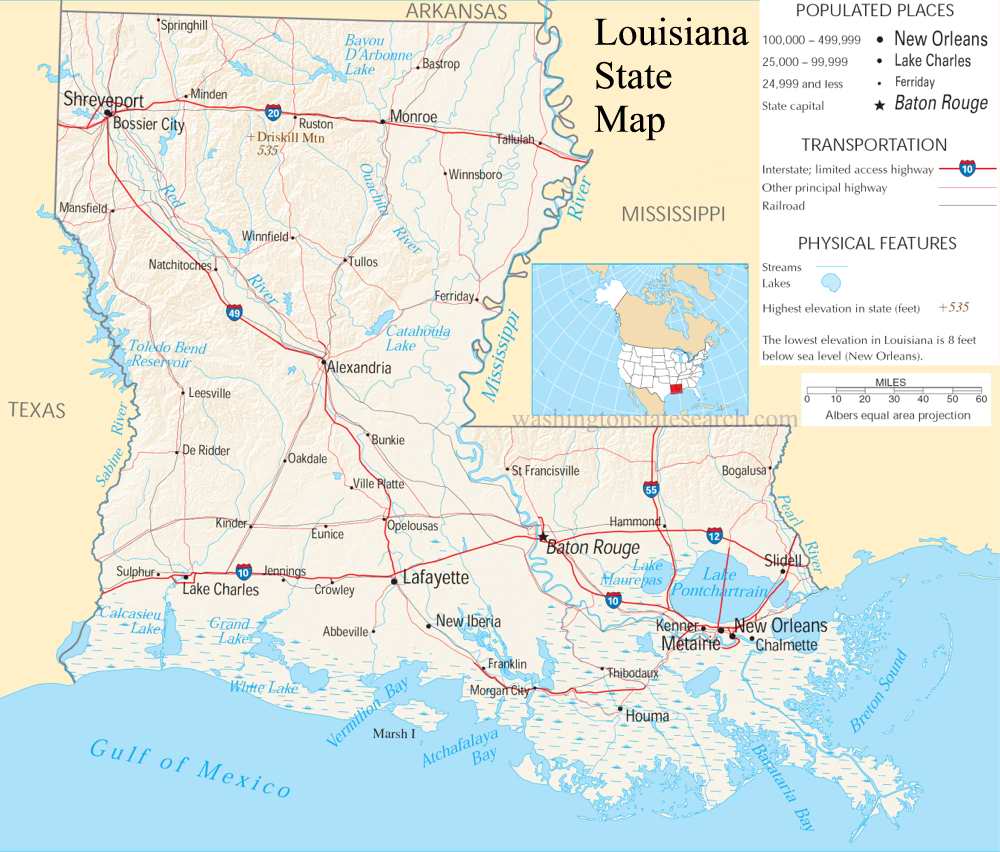
from the National Atlas of the United States
United States Department of the Interior
Louisiana State Map
Explore Louisiana with an interactive map featuring Street View, satellite and terrain views. Live weather, local news and location details for Louisiana — plus links to detailed street maps for 449 cities and towns across the state.
Map search is available for a limited number of queries per session to manage costs. Be specific — search precisely for best results.
| State | Louisiana (LA) |
| Capital | Baton Rouge |
| Largest City | New Orleans |
| Country | United States |
| Latitude | 31.16996 |
| Longitude | -91.867805 |
| Population | 4,657,757 |
| Cities & Towns | 449 |
Louisiana stretches across a low, damp expanse where the land seems less a solid foundation and more a porous negotiation between silt and tide. The Mississippi River carves a deep, serpentine artery through the center, depositing the rich, dark sediment that defines the fertility of the deltaic plain. To the west, the coastal prairies give way to a labyrinth of bayous, where cypress knees emerge from still, tea-colored water like the fingers of a submerged forest. At dusk, the light loses its sharpness, bruising into shades of violet and bruised gold that press against the humid air, cooling the swamp until the evening chorus of frogs begins its steady, rhythmic pulse. This is a geography of constant movement, where the coastline is perpetually reshaped by the currents and the slow, inexorable pull of the Gulf of Mexico.
Indigenous nations cultivated these riverbanks for millennia before the arrival of European powers, establishing complex networks of trade and society long before the shifting allegiances of empires turned the territory into a chessboard. French, Spanish, and later American interests collided here, leaving behind a legacy of civil law and shifting borders that shaped the state’s distinct political anatomy. When Louisiana entered the Union, it brought with it a social architecture defined by the persistence of its early inhabitants and the arrival of those forced into labor, creating a society that never fully homogenized. The weight of this past lingers in the architecture of the older parishes, where the brick walls seem to hold the heat of centuries, and the quiet dignity of the landscape bears witness to the endurance of those who carved their lives out of the swampy wilderness.
Agriculture and industry here operate under the heavy influence of the water, which dictates the rhythm of production as much as any market demand. Fields of sugarcane extend toward the horizon in emerald rows, while the flooded plains provide the necessary environment for rice cultivation, a practice that has anchored the rural economy for generations. Beyond the fields, the state remains a vital corridor for global commerce, with massive tankers navigating the deep-water channels that serve as the throat of the nation’s interior trade. Industrial plants, their metallic silhouettes often looming against a heavy, gray sky, stand in contrast to the quiet, mud-slicked banks where small-scale fishing and trapping still persist. It is a place where the extraction of mineral wealth exists in uneasy proximity to the fragile, marshy ecosystems that define the state’s physical identity.
Cultural life in Louisiana thrives in the spaces between the formal and the vernacular, expressed through a devotion to music that ranges from the improvisational complexity of jazz to the percussive, driving energy of zydeco. Food serves as a primary language, with recipes passed down with the precision of a ritual, relying on the local abundance of seafood and the specific heat of peppers grown in the damp soil. The pace of daily life is dictated by the climate, which demands a certain patience; when the air turns heavy and motionless, the world seems to slow, allowing for a contemplative pause that finds its way into the local cadence of speech. Whether at a collegiate stadium filled with the roar of a Saturday crowd or in a quiet neighborhood where the scent of woodsmoke hangs in the humid air, the people maintain a fierce attachment to their traditions, finding beauty in the persistence of their own unique, unhurried ways.
Louisiana City and Town Maps
A
B
C
D
E
F
G
H
I
J
K
L
M
N
O
P
R
S
T
V
W
Louisiana Maps — Interactive Map, Street View, Weather & News
This page provides an interactive Google map of Louisiana (LA) with Street View, satellite and terrain views, alongside links to detailed street maps for 449 cities and towns across the state. The state capital is Baton Rouge and the largest city is New Orleans, with a state population of approximately 4,657,757.
Each city and town map page includes an embedded street and satellite map. Live weather where available combines National Weather Service forecasts with Open-Meteo graphical data including hourly and 7-day outlooks. Local and world news, Wikipedia location summaries, and precise GPS coordinates are included where available.
Location data is sourced from the USGS GNIS database and verified by coordinates, not name matching alone.
