A large detailed map of Nebraska State
This is a large, detailed map of Nebraska. There are links to many Nebraska localities below. Our website format reduces the display size for uniformity. Here is a link to the full-size image that is more easily readable.
View our Nebraska State county map
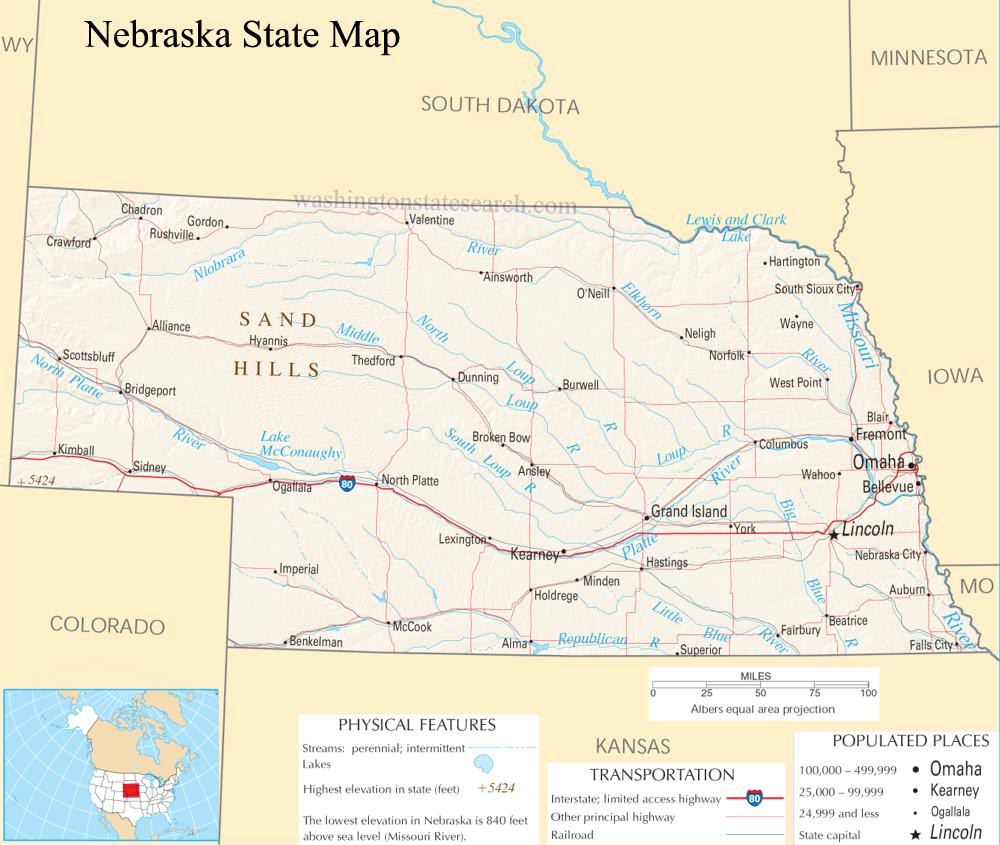
from the National Atlas of the United States
United States Department of the Interior
Nebraska State Map
Explore Nebraska with an interactive map featuring Street View, satellite and terrain views. Live weather, local news and location details for Nebraska — plus links to detailed street maps for 591 cities and towns across the state.
Map search is available for a limited number of queries per session to manage costs. Be specific — search precisely for best results.
| State | Nebraska (NE) |
| Capital | Lincoln |
| Largest City | Omaha |
| Country | United States |
| Latitude | 41.12537 |
| Longitude | -98.268082 |
| Population | 1,961,504 |
| Cities & Towns | 591 |
Nebraska stretches across a vast meridian where the earth yields its secrets to the sky, shifting from the emerald, deep-rooted tallgrass of the east into the high, arid architecture of the shortgrass plains. The land is defined by the Platte, a river that moves with a deceptive, sluggish grace, its wide and braided channels shimmering like spilled quicksilver under the relentless sun. To the north and west, the Sandhills rise in a vast, grassy sea, a stabilized dune system held together by tough, resilient prairie fibers that ripple in the wind like the surface of a deep ocean. The horizon functions as the primary fact of life here, a sharp, unyielding line that separates the heavy, dark earth from the expansive, changing blue, forcing the traveler to confront the sheer scale of the continent with every mile driven.
Indigenous nations—the Omaha, Ponca, Pawnee, and Otoe-Missouria—long moved across these reaches before the heavy iron of the transcontinental railroad and the wooden plow began to divide the commons. The era of the pioneer remains a foundational ghost, a memory of sod houses and hard-won homesteads that persists in the collective consciousness. Nebraska entered the Union during a period of fierce national fracture, its identity forged in the crucible of Manifest Destiny and the grueling, rhythmic labor of breaking ground that had never known a fence. This history is not merely a record of dates but a lingering imprint on the landscape, visible in the way the old wagon ruts still ghost the hillsides and in the quiet, stoic pride of those who claim the state as their own.
Agriculture remains the pulse of the regional economy, though the nature of that labor has shifted from the solitary toil of the early settler to the sophisticated, high-capacity machinery that now combs the fields. Great center-pivot irrigation systems turn the landscape into a geometric mosaic of vibrant green, a testament to the mastery of the vast Ogallala Aquifer that lies beneath the soil. Beyond the harvest of corn and soybeans, the state sustains a massive cattle industry, where the livestock graze against a backdrop of wide, empty space that makes the animals appear small and solitary. The industry here is quiet and intense, tethered to the seasons and the unpredictable temperament of the weather, producing a rhythm of life that is governed by the planting and the reaping, the heavy snows of winter, and the humid, electric heat of late summer.
Cultural life in Nebraska often centers on the shared devotion to collegiate athletics, where a stadium becomes a temporary capital city, drawing thousands to witness a spectacle that anchors the neighborhood and the state alike. Literature here carries the quiet, melancholic weight of the prairie, reflected in the prose of those who captured the lonely struggle of the immigrant and the solitary beauty of the wind-swept plains. In the small towns, the county-seat clock tower continues to mark the passage of time for a community that values a steady, reliable pace, often punctuated by the smell of rain on dry dust or the sight of the sun sinking into a bruised, violet twilight. It is a place that demands much of its people, offering in return a rare, expansive silence and the profound comfort of a landscape that does not pretend to be anything other than what it is.
Nebraska City and Town Maps
A
B
C
D
E
F
G
H
L
M
N
O
P
R
S
T
W
Y
Nebraska Maps — Interactive Map, Street View, Weather & News
This page provides an interactive Google map of Nebraska (NE) with Street View, satellite and terrain views, alongside links to detailed street maps for 591 cities and towns across the state. The state capital is Lincoln and the largest city is Omaha, with a state population of approximately 1,961,504.
Each city and town map page includes an embedded street and satellite map. Live weather where available combines National Weather Service forecasts with Open-Meteo graphical data including hourly and 7-day outlooks. Local and world news, Wikipedia location summaries, and precise GPS coordinates are included where available.
Location data is sourced from the USGS GNIS database and verified by coordinates, not name matching alone.
