A large detailed map of Utah State
This is a large, detailed map of Utah. There are links to many Utah localities below. Our website format reduces the display size for uniformity. Here is a link to the full-size image that is more easily readable.
View our Utah State county map
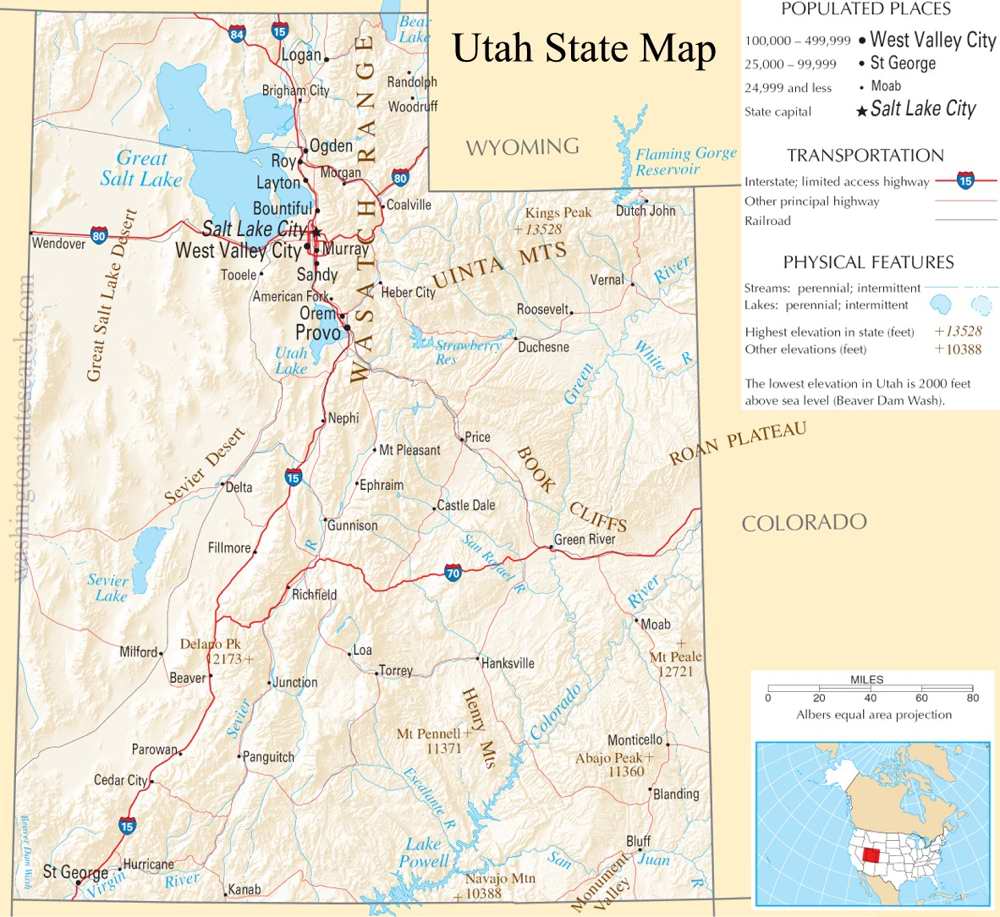
from the National Atlas of the United States
United States Department of the Interior
Utah State Map
Explore Utah with an interactive map featuring Street View, satellite and terrain views. Live weather, local news and location details for Utah — plus links to detailed street maps for 305 cities and towns across the state.
Map search is available for a limited number of queries per session to manage costs. Be specific — search precisely for best results.
| State | Utah (UT) |
| Capital | Salt Lake City |
| Largest City | Salt Lake City |
| Country | United States |
| Latitude | 40.150032 |
| Longitude | -111.862434 |
| Population | 3,271,616 |
| Cities & Towns | 305 |
Utah presents a landscape of stark, geological extremes, defined by the collision of two distinct worlds. To the north, the Wasatch Range rises like a jagged wall of granite, trapping the winter snows that feed the valleys below and the terminal, shimmering expanse of the Great Salt Lake. This high-altitude basin gives way to the south, where the earth drops into a labyrinth of sandstone, mesas, and deep, vertical fissures. In these arid southern reaches, the light at dusk turns the iron-rich cliffs into a deep, bruised violet, a color so intense it seems to vibrate against the cooling air. The rivers here, the Colorado and the Green, act as slow, relentless architects, cutting through miles of stone to expose the slow-motion history of the planet in layers of red, white, and ochre.
Indigenous nations—including the Ute, Paiute, Goshute, and Diné—held these canyons and basins for generations, developing a deep, ancestral familiarity with the water sources and the cycle of the seasons. European expansion arrived in the nineteenth century, driven by a religious migration that sought isolation from a world they perceived as hostile. This movement brought a geometric discipline to the land, organizing towns around wide, grid-iron streets and irrigation ditches that transformed the desert floor into rows of poplars and fruit orchards. Utah became a territory and eventually a state through a difficult, protracted negotiation of identity, balancing the rigid requirements of a communal faith against the encroaching pressures of the federal government and the broader American frontier.
Economic life in Utah has evolved from the early necessity of subsistence farming into a diverse engine of industry, technology, and energy. Early settlers labored to tame the alkaline soil, building canals to coax grain and alfalfa from the dust, a struggle that remains etched in the state's cultural memory. Over time, the extraction of copper and coal provided a different kind of harvest from the rock, while the modern era has seen the rise of aerospace, software, and financial sectors that operate in the shadow of the mountains. Today, the high-tech corridors hum with a different sort of labor, though the underlying impulse remains the same: a desire to build something durable in a place that is, by its very nature, prone to drought, wind, and the relentless heat of the high desert.
Cultural character in Utah is shaped by a quiet, persistent intensity, reflecting a population that values both industry and the profound stillness of the outdoors. In the ski-resort towns, the air carries a crisp, thin quality that sharpens the senses, while the collegiate stadiums provide a loud, collective release for the community’s competitive spirit. The pace of life varies between the rapid growth of the urban centers and the deliberate, slow-turning rhythm of the rural outposts, where the silence of the desert is rarely broken by anything louder than the wind. Literature and music in the region often grapple with this duality—the tension between the individual’s desire for open space and the collective’s need for order. Utah remains a place where the horizon is always present, a constant reminder that the human presence here is small, temporary, and entirely dependent on the grace of the land.
Utah City and Town Maps
B
C
D
E
F
G
H
I
K
L
M
N
O
P
R
S
T
W
Utah Maps — Interactive Map, Street View, Weather & News
This page provides an interactive Google map of Utah (UT) with Street View, satellite and terrain views, alongside links to detailed street maps for 305 cities and towns across the state. The state capital is Salt Lake City and the largest city is Salt Lake City, with a state population of approximately 3,271,616.
Each city and town map page includes an embedded street and satellite map. Live weather where available combines National Weather Service forecasts with Open-Meteo graphical data including hourly and 7-day outlooks. Local and world news, Wikipedia location summaries, and precise GPS coordinates are included where available.
Location data is sourced from the USGS GNIS database and verified by coordinates, not name matching alone.
