A large detailed map of Montana State
This is a large, detailed map of Montana. There are links to many Montana localities below. Our website format reduces the display size for uniformity. Here is a link to the full-size image that is more easily readable.
View our Montana State county map
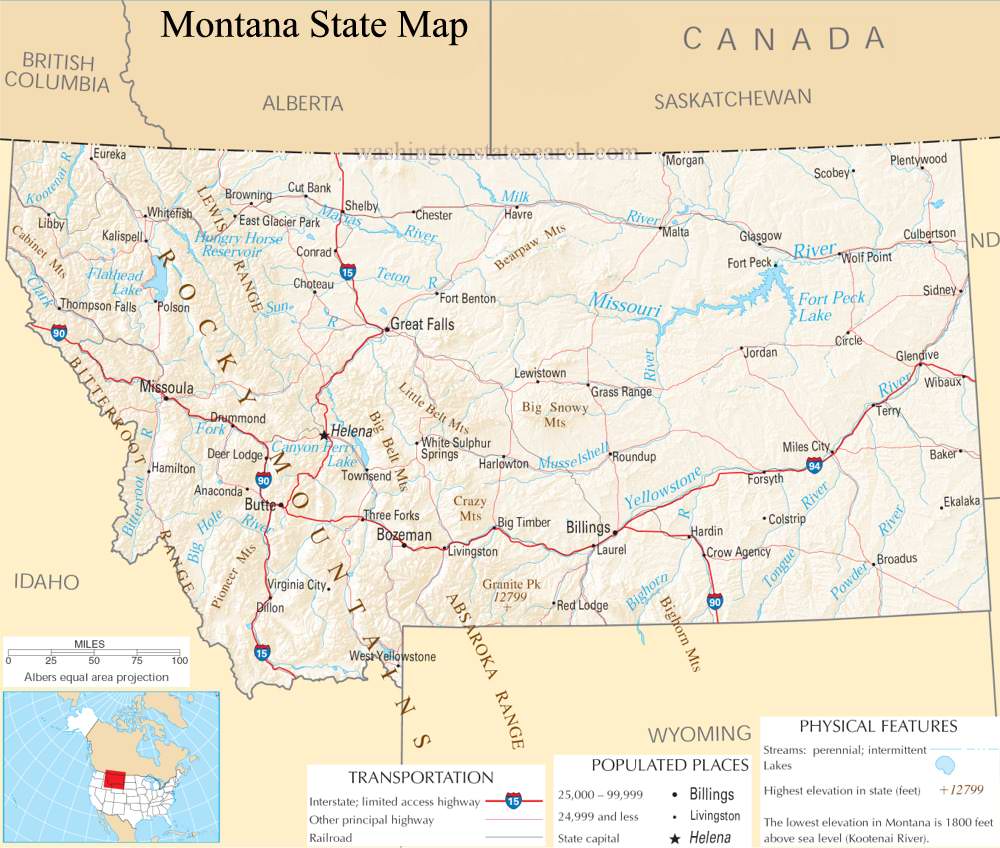
from the National Atlas of the United States
United States Department of the Interior
Montana State Map
Explore Montana with an interactive map featuring Street View, satellite and terrain views. Live weather, local news and location details for Montana — plus links to detailed street maps for 488 cities and towns across the state.
Map search is available for a limited number of queries per session to manage costs. Be specific — search precisely for best results.
| State | Montana (MT) |
| Capital | Helena |
| Largest City | Billings |
| Country | United States |
| Latitude | 46.921925 |
| Longitude | -110.454353 |
| Population | 1,084,225 |
| Cities & Towns | 488 |
Montana divides itself along a jagged meridian, where the serrated limestone spines of the Rockies abruptly surrender to the vast, muscular flatness of the high plains. In the west, the landscape is defined by verticality and the cold, glacial melt of rivers that carve deep, shadowed canyons into the earth, their waters running with the clarity of hammered glass. To the east, the geography flattens into an immense prairie sea, where the horizon exerts a physical pressure on the traveler, pushing the sky into a wide, vaulted dome that seems to hold more light than the earth below. The air here carries a distinct, sharp metallic edge, particularly in the autumn when the heat of the day dissipates into a sudden, biting frost that turns the sagebrush a bruised shade of silver.
Indigenous nations—the Blackfeet, Crow, Salish, and others—held these river valleys and hunting grounds for generations before the arrival of explorers and the subsequent, violent collision of cultures that defined the nineteenth century. The narrative of Montana is written in the debris of this expansion: the abandoned mining camps, the rusted tracks of transcontinental railroads, and the treaties that were signed only to be broken by the hunger for gold and grazing land. Statehood arrived as an afterthought to the frantic extraction of copper and silver, transforming a wild frontier into a political entity shaped by the conflicting impulses of rugged individualism and the cold, mechanical efficiency of corporate mining interests. The ghosts of this era remain, lingering in the weathered timber of homestead cabins that lean into the wind, waiting for the prairie grass to eventually reclaim their foundations.
Economic life in Montana has always been a negotiation with the constraints of distance and climate, alternating between the cycles of dryland wheat farming and the heavy, industrial labor of the mines. Ranching remains the primary pulse of the rural interior, requiring a stoic endurance against winters that can turn iron brittle and silence the land for months on end. While the shift toward a service-oriented economy has introduced new pressures, the state continues to draw its identity from the tangible production of commodities—timber, grain, and mineral wealth—that bind the population to the seasons. A grain elevator standing against a bruised, violet dusk is not merely a structure but a sentinel, marking the slow, deliberate work of a people who have learned to measure their prosperity by the weight of a harvest or the health of a calf crop.
Cultural expression in Montana finds its cadence in the quiet spaces between the noise of modern life, favoring a reserve that mirrors the immense, open geography. Literature and music here often grapple with the tension between the myth of the solitary frontiersman and the reality of small, tight-knit communities where everyone is tethered to the same social gravity. Collegiate sports provide a necessary, seasonal friction, drawing thousands into stadiums that feel oddly exposed against the backdrop of the mountains, yet the pace of life remains tethered to the sun and the unpredictable mood of the weather. There is a particular, unforced dignity in the way a rancher or a fly-fisherman moves through the day—a deliberate, measured energy that acknowledges the indifference of the wild landscape while insisting on the necessity of human connection.
Montana City and Town Maps
A
B
C
D
E
F
G
H
I
J
K
L
M
N
O
P
R
S
T
U
V
W
Z
Montana Maps — Interactive Map, Street View, Weather & News
This page provides an interactive Google map of Montana (MT) with Street View, satellite and terrain views, alongside links to detailed street maps for 488 cities and towns across the state. The state capital is Helena and the largest city is Billings, with a state population of approximately 1,084,225.
Each city and town map page includes an embedded street and satellite map. Live weather where available combines National Weather Service forecasts with Open-Meteo graphical data including hourly and 7-day outlooks. Local and world news, Wikipedia location summaries, and precise GPS coordinates are included where available.
Location data is sourced from the USGS GNIS database and verified by coordinates, not name matching alone.
