A large detailed map of South Dakota State
This is a large, detailed map of South Dakota. There are links to many South Dakota localities below. Our website format reduces the display size for uniformity. Here is a link to the full-size image that is more easily readable.
View our South Dakota State county map
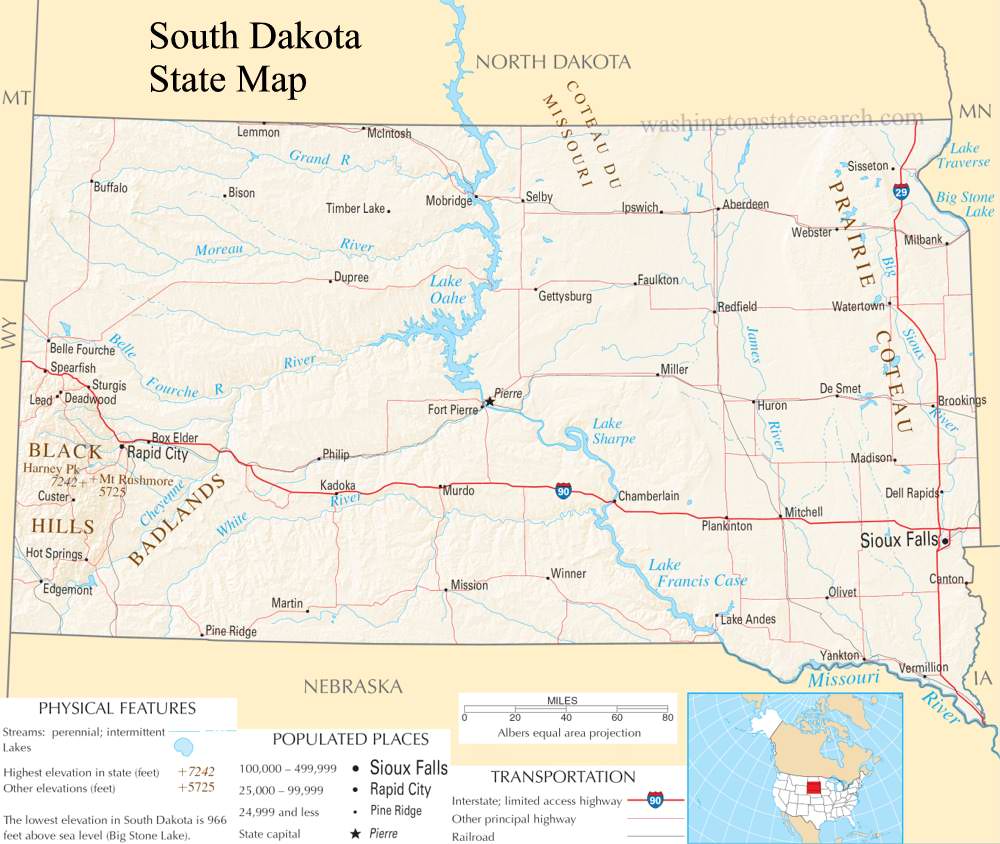
from the National Atlas of the United States
United States Department of the Interior
South Dakota State Map
Explore South Dakota with an interactive map featuring Street View, satellite and terrain views. Live weather, local news and location details for South Dakota — plus links to detailed street maps for 480 cities and towns across the state.
Map search is available for a limited number of queries per session to manage costs. Be specific — search precisely for best results.
| State | South Dakota (SD) |
| Capital | Pierre |
| Largest City | Sioux Falls |
| Country | United States |
| Latitude | 44.299782 |
| Longitude | -99.438828 |
| Population | 886,667 |
| Cities & Towns | 480 |
South Dakota divides itself into two distinct realms, severed by the wide, sediment-heavy ribbon of the Missouri River. To the east, the land is a vast, disciplined geometry of glacial till and flat horizons, where the prairie yields to the heavy machinery of modern cultivation. Westward, the terrain shatters into the jagged, rusted spires of the Badlands and the dense, pine-darkened rise of the Black Hills. Here, the air thins and sharpens, carrying a scent of dry needles and cooling granite. At dusk, the light in the western reaches loses its midday glare, turning the sandstone formations into a bruised, shifting violet that seems to hold the heat of the day long after the sun has vanished behind the mountain rim.
Indigenous nations—the Oceti Sakowin—have long held these plains as a central geography of their existence, and the weight of that stewardship remains palpable in the silence of the high mesas. European arrival arrived in waves of fur traders and gold seekers, each group leaving scars that have never fully faded from the collective memory. Statehood arrived in the late nineteenth century as a formalization of an uneasy frontier, tethering a sprawling, untamable territory to the federal map. The history of South Dakota is marked by the sharp collision of cultures, a narrative defined by treaty lines drawn in ink and then broken by the relentless, grinding pressure of westward expansion that sought to claim the earth for fences and rails.
Agriculture remains the primary pulse of the economy, a quiet, repetitive labor that dictates the state’s seasonal clock. Farmers and ranchers manage vast tracts of corn, soy, and wheat, while cattle graze the shortgrass prairies with a slow, deliberate persistence. In the industrial pockets, manufacturing and financial services have emerged to supplement the traditional reliance on the soil, yet the state’s identity remains tethered to the production of raw commodities. There is a particular, austere beauty in the sight of a combine harvester moving through a field under a vast, cloud-streaked sky, the machine’s yellow frame a stark contrast to the muted ochre of the ripening grain, signaling a cycle of planting and harvest that has sustained the local populace for generations.
Cultural life in South Dakota moves at the pace of a long-distance traveler, favoring a reserved pragmatism over the frantic energy of coastal centers. Collegiate athletics serve as the primary communal focus, drawing thousands to stadiums where the wind often dictates the flight of a football as much as the players do. The culinary landscape is dominated by simple, sturdy fare—wild game, local beef, and the ubiquitous fry bread that serves as a quiet reminder of the state’s complex heritage. Music and literature here often reflect the isolation of the landscape, favoring a folk-inflected storytelling that acknowledges the immense scale of the sky. In the small neighborhood cafes and quiet town squares, conversation is sparse and careful, a reflection of a people who have learned that words, like rain in the high plains, are best used sparingly and with intention.
South Dakota City and Town Maps
A
B
C
D
E
F
G
H
L
M
N
O
P
R
S
T
V
W
South Dakota Maps — Interactive Map, Street View, Weather & News
This page provides an interactive Google map of South Dakota (SD) with Street View, satellite and terrain views, alongside links to detailed street maps for 480 cities and towns across the state. The state capital is Pierre and the largest city is Sioux Falls, with a state population of approximately 886,667.
Each city and town map page includes an embedded street and satellite map. Live weather where available combines National Weather Service forecasts with Open-Meteo graphical data including hourly and 7-day outlooks. Local and world news, Wikipedia location summaries, and precise GPS coordinates are included where available.
Location data is sourced from the USGS GNIS database and verified by coordinates, not name matching alone.
