A large detailed map of Minnesota State Counties
Explore Minnesota with an interactive map featuring Street View, satellite and terrain views. Browse all 87 counties of Minnesota below, with links to every city and town map page. Live weather and local news are included on every location page.
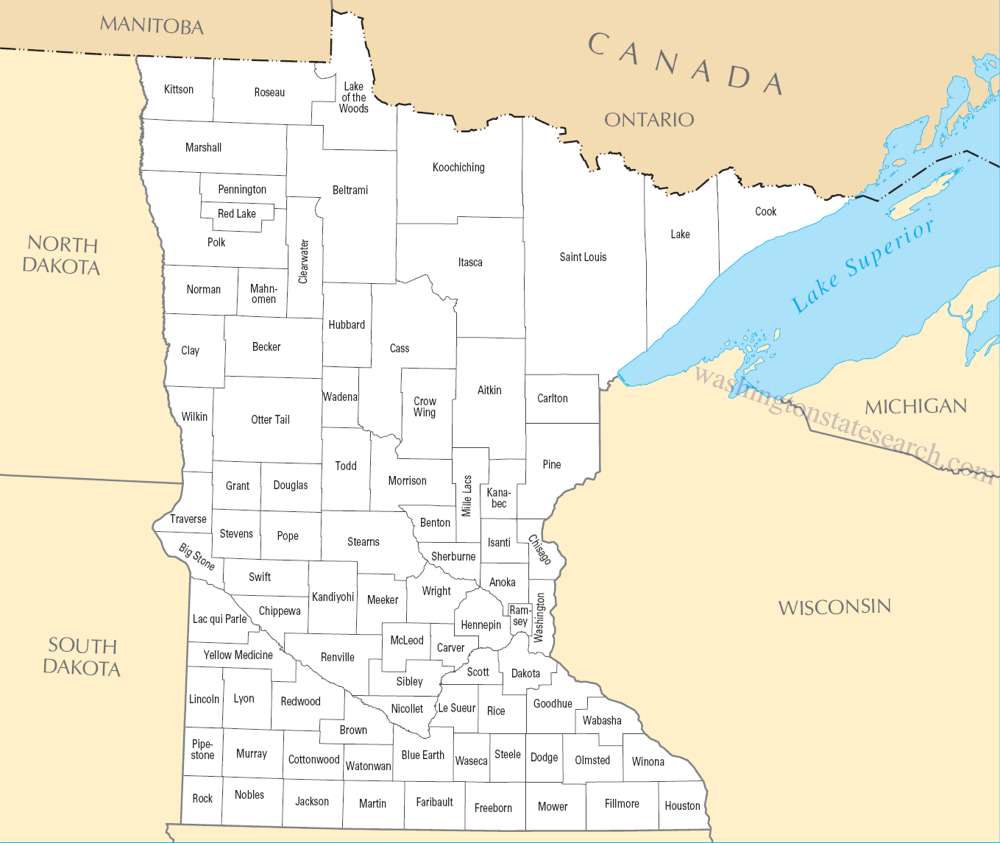
from the National Atlas of the United States
United States Department of the Interior
Minnesota State Map
Map search is available for a limited number of queries per session to manage costs. Be specific — search precisely for best results.
| State | Minnesota |
| Capital | Saint Paul |
| Country | United States of America |
| Counties | 87 |
| Latitude | 45.694454 |
| Longitude | -93.900192 |
| Cities & Towns | 911 |
| State Map | Minnesota Maps |
About Minnesota
Minnesota occupies a vast, glaciated expanse where the landscape shifts from the deep, coniferous shadows of the North Woods to the expansive, open prairies of the west. Water serves as the primary architect of this geography, carving the granite basins of the northeast and funneling southward through a thousand intricate channels. At the headwaters of the Mississippi, the river begins as a modest, clear stream, barely wide enough to wade across, before it gathers the momentum of countless tributaries. The terrain is defined by the remnants of ice sheets that left behind a stubborn, rocky soil in the northern reaches and a profound depth of dark, nutrient-rich loam across the southern basin. In the autumn, the light pulls long and thin across the marshes, turning the surface of the lakes into mirrors of burnished copper just before the first frost seals them shut.
Indigenous nations, primarily the Dakota and Ojibwe, established complex societies across these waterways long before the arrival of European fur traders and missionaries. Minnesota emerged as a territory of strategic importance, where the confluence of rivers acted as a gateway for the exchange of pelts and timber. Statehood in the middle of the nineteenth century accelerated a wave of migration that brought settlers from northern Europe, who recognized in the harsh, sub-zero winters and dense forests a climate not unlike their ancestral homes. These populations brought with them traditions of communal labor and austere endurance, building schools and cooperatives that solidified the social order. The landscape still holds the quiet gravity of those early frontier days, where the silence of a snow-covered clearing feels as heavy and permanent as the stone foundations of the oldest farmhouses.
Agriculture and heavy industry have long defined the practical rhythm of life here, creating a reliance on the raw materials extracted from the earth. The rugged Iron Range once fueled the nation’s industrial expansion, while the expansive fields of the south produce a steady, essential yield of corn, soybeans, and wheat that feeds far beyond the state borders. This reliance on the land fostered a culture of mechanical ingenuity and a pragmatic approach to the changing seasons, where the economy must account for a landscape that is frozen and dormant for nearly half the year. In the gray, biting air of a mid-winter morning, the hum of machinery in grain elevators and manufacturing plants provides a steady, rhythmic pulse, suggesting a society that measures its progress not by grand gestures, but by the reliable output of its mills and the careful stewardship of its fields.
Cultural life in Minnesota is marked by a distinctive reserve, a social architecture that values understated speech and a cautious, neighborly cooperation. The long winters have encouraged a tradition of indoor congregation, nurturing a vibrant community of writers, musicians, and collegiate sports enthusiasts who find warmth in the shared pursuit of excellence. Foodways reflect the heritage of the early immigrants, favoring hearty, comforting preparations designed to sustain one through the bitter, sub-zero shifts of the mercury. There is a particular quality to the evening here, when the sun dips below the horizon and the air turns brittle, that brings a sudden, sharp clarity to the mind. This is a place that demands a certain level of fortitude, rewarding those who accept the stillness of the landscape with a deep, quiet pride in the ability to thrive where the climate is indifferent to human comfort.
Minnesota Cities and Towns by County
Anoka County
Becker County
Blue Earth County
Carver County
Cass County
Chisago County
Crow Wing County
Dakota County
Douglas County
Freeborn County
Goodhue County
Hennepin County
Itasca County
Kittson County
Le Sueur County
Mahnomen County
Marshall County
Mower County
Otter Tail County
Pine County
Ramsey County
St. Louis County
Stearns County
Todd County
Washington County
Winona County
Wright County
Minnesota County Maps & Location Information
This page provides an interactive Google map of Minnesota (MN) with Street View, satellite and terrain views, alongside links to detailed street maps for all 911 cities and towns across the state organised by county. Minnesota has 87 counties, with the state capital at Saint Paul.
Every locality page includes an embedded street and satellite map alongside live weather where available — combining National Weather Service forecasts with Open-Meteo graphical data including hourly observations and 7-day outlooks. Local and world news feeds, Wikipedia summaries and editorially written descriptions are included where available.
Location data is sourced from the USGS GNIS database and the SimpleMaps US Cities dataset, verified by coordinates rather than name matching alone.
