A large detailed map of Indiana State
This is a large, detailed map of Indiana. There are links to many Indiana localities below. Our website format reduces the display size for uniformity. Here is a link to the full-size image that is more easily readable.
View our Indiana State county map
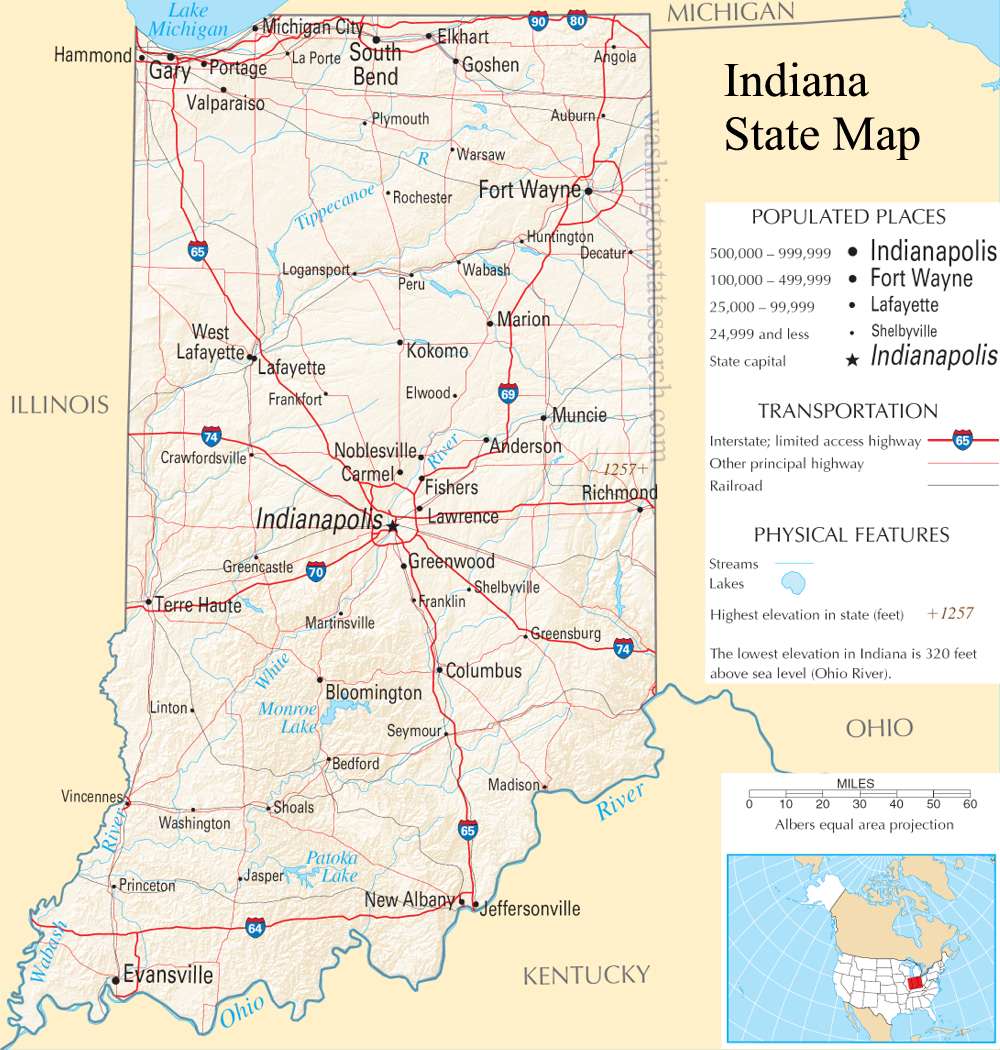
from the National Atlas of the United States
United States Department of the Interior
Indiana State Map
Explore Indiana with an interactive map featuring Street View, satellite and terrain views. Live weather, local news and location details for Indiana — plus links to detailed street maps for 987 cities and towns across the state.
Map search is available for a limited number of queries per session to manage costs. Be specific — search precisely for best results.
| State | Indiana (IN) |
| Capital | Indianapolis |
| Largest City | Indianapolis |
| Country | United States |
| Latitude | 39.849426 |
| Longitude | -86.258278 |
| Population | 6,785,528 |
| Cities & Towns | 987 |
Indiana defines itself through a glacial legacy that flattened the northern reaches into a vast, fertile plain while leaving the southern half to fracture into rugged, limestone-ribbed ridges. To the north, the land meets Lake Michigan with a sudden, wild defiance, where shifting sand dunes rise against the gray expanse of water and the hulking silhouettes of steel mills. Moving southward, the terrain softens into a mosaic of woodlots and black-soil fields, punctuated by the slow, steady progress of the Wabash and White Rivers. In the deep south, the topography gains a sharper edge, where the Ohio River carves a boundary against the hills, and the light at dusk catches the pale, porous stone of the quarries, turning the earth a bruised, luminous silver that feels older than the maps suggest.
Indigenous nations, including the Miami, Potawatomi, and Delaware, moved through these river valleys for generations, leaving a legacy of trail systems that modern roads still shadow. European influence arrived first through the French fur trade, followed by a steady push of settlers who arrived by flatboat or wagon, seeking the promise of self-sufficiency. Indiana transitioned into statehood during a time of intense territorial friction, shaped by the push to clear the dense forests and drain the marshy prairies for the plow. This era of transformation established a baseline of independence, where the necessity of survival in a raw, changing landscape fostered a skepticism of outside authority and a deep, quiet loyalty to the local clearing or the family farm.
Industry and agriculture operate here as twin pulses, often beating in the same space. The state remains a primary engine for corn and soybean harvests, where the horizon is defined by the rigid geometry of rows and the towering geometry of grain elevators that stand like sentinels against the sky. Beyond the fields, Indiana maintains a heavy, muscular industrial identity, rooted in the production of automotive parts, pharmaceutical research, and the refined output of its mills. The air in these industrial corridors often carries the metallic, ozone scent of labor, a sharp contrast to the damp, loamy smell of the fields after a spring rain. This dual economy has forced a pragmatic flexibility upon the people, who have learned to pivot between the seasonal rhythms of the harvest and the relentless, clock-driven demands of the factory floor.
Hoosier identity finds its most vocal expression in the shared fervor for basketball, a sport that functions less as a pastime and more as a winter religion in towns where the high school gymnasium is the largest, most brightly lit building for miles. This devotion is mirrored in a literary tradition that favors the vernacular, capturing the dry wit and plainspoken wisdom of people who prefer observation to grandiosity. Music, from the early influence of jazz and blues along the river to the folk traditions of the interior, retains a rhythmic, grounded quality that matches the slow, deliberate pace of life. On a quiet evening, when the heat of the day lifts from the asphalt and the crickets begin their steady, metallic drone, one can sense the state’s character: a blend of persistent labor, a love for the local team, and a fundamental comfort in the unadorned reality of the Midwestern plains.
Indiana City and Town Maps
A
B
C
D
E
F
G
H
I
J
K
L
M
N
O
P
R
S
T
U
V
W
Y
Z
Indiana Maps — Interactive Map, Street View, Weather & News
This page provides an interactive Google map of Indiana (IN) with Street View, satellite and terrain views, alongside links to detailed street maps for 987 cities and towns across the state. The state capital is Indianapolis and the largest city is Indianapolis, with a state population of approximately 6,785,528.
Each city and town map page includes an embedded street and satellite map. Live weather where available combines National Weather Service forecasts with Open-Meteo graphical data including hourly and 7-day outlooks. Local and world news, Wikipedia location summaries, and precise GPS coordinates are included where available.
Location data is sourced from the USGS GNIS database and verified by coordinates, not name matching alone.
